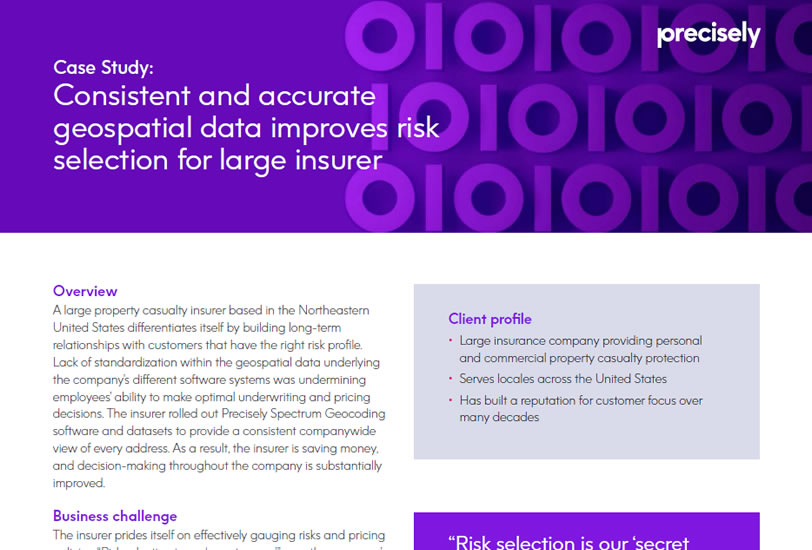





Data management solutions for insurance
Price policies with confidence, respond to claims with speed, and enhance risk assessment to create better policyholder experiences.
A data foundation insurers trust when stakes are high
In insurance, bad data creates liability: mispriced policies, undetected fraud, and indefensible decisions made by AI models. Create a competitive advantage across underwriting, claims, catastrophe modeling, and more with Precisely solutions.

Improving the speed and accuracy of catastrophe risk
Willis Re makes exposure assessments more efficient for clients in over 150 countries, while meeting strict regulatory requirements.

Price risk accurately from the address up
When your geocode places a property at the parcel center, not the structure, your risk elevation scores are wrong – and so is your price. Place every structure exactly with rooftop-level geocoding for accurate underwriting.
- See accurate flood zone, wildfire boundary, and elevation risk with rooftop-level geocoding that places structures at their exact location
- Get deeper exposure analysis with the PreciselyID, linking every address to curated, connected datasets including wildfire propensity, flood history, weather patterns, and building attributes.
- Identify co-tenant and adjacency risk, aggregate exposure, and catastrophe scenario modeling at the portfolio level with spatial analytics.
Insurance data management for catastrophic risk and climate exposure
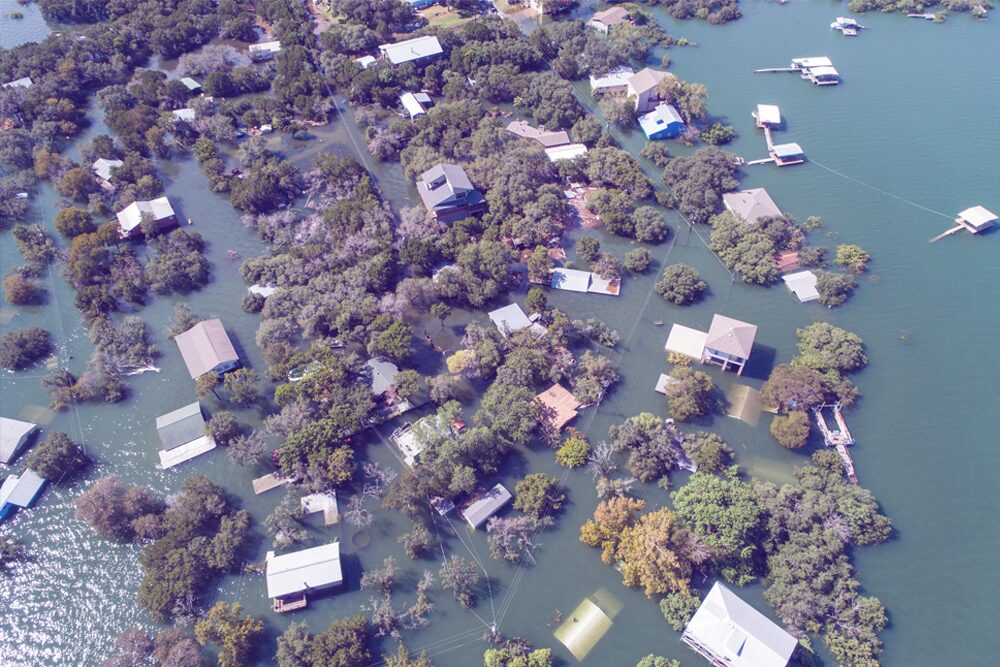
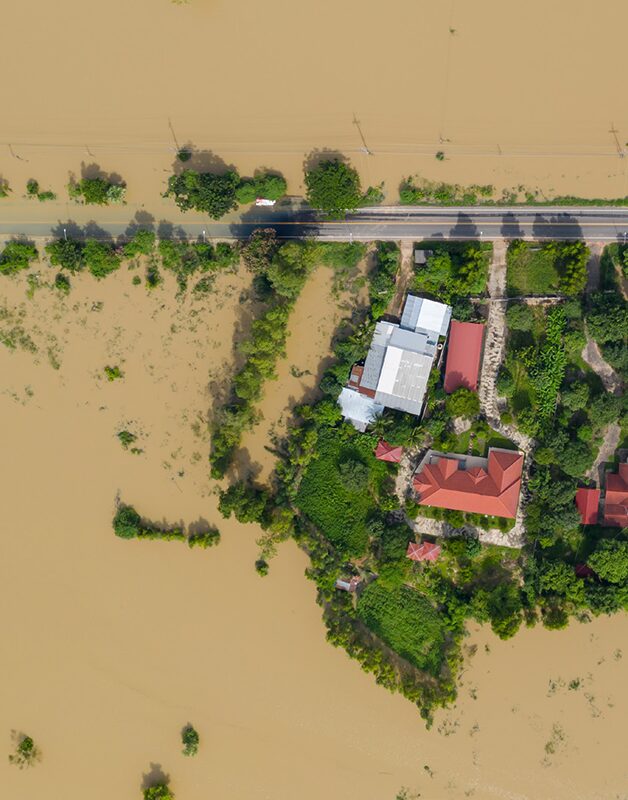
Traditional risk models built on historical data underestimate today’s catastrophe exposure. Ensure you can price and write business where others withdraw by assessing insurance underwriting data at the address level – current elevation models, vegetation density, and landscape mitigation factors included.
- Comprehensive wildfire data tracks moisture levels, vegetation density, landscape mitigation, wind dryness, and more for near-real-time risk monitoring.
- Weather and flood datasets provide hyper-local historical event data and current hazard boundaries at the address level.
- Portfolio modeling identifies aggregate exposure concentration before a catastrophe event rather than after it.

Improved underwriting and customer experience with geolocation data
Abeille Assurances deployed Precisely location intelligence across 12 projects, giving 95+ users autonomous access to accurate geospatial data.

Solve insurance claims and fraud challenges with address data quality
CHALLENGEA claim comes in with an address that doesn’t match the one on the policy. You can’t tell whether the property was in the affected zone
Address data failures create fraud exposure. A minor spelling variation can let a fraudulent claim through.
SOLUTIONClose the gap with accurate address data.
Ensure data quality across insurance address records by validating, standardizing, and geocoding every address at point of entry, linking it to the PreciselyID for consistent reference across systems, and flagging discrepancies between policy and claims data before they become fraud losses.

Greater efficiency and new revenue opportunities
Helvetia Group combined spatial operations with pricing and underwriting into a single platform to eliminate manual workflows, accelerate regulatory response, and reveal cross-sell opportunities.
Improve policyholder experience and AI results with data quality and governance
Unlock more accurate cross-sell targeting, better customer experiences, and defensible AI outcomes by connecting the data across your policy, billing, claims, and CRM systems. It starts with a governed, enriched single view of each policyholder.
- Inform cross-sell motions and provide consistent service with a single policyholder view across policy, billing, claims, and CRM using data quality and master data management.
- Demonstrate data provenance when regulators review pricing or claims models with data governance that provides lineage and ownership for every AI model input.
- Drive accurate market analysis and customer acquisition with AI-ready enrichment datasets that connect demographic, property, and business context to every policyholder address.
What insurers get when their data is right
- Price policies accurately with underwriting data at the rooftop level, not the parcel center
- Detect and prevent fraud by validating every address with data quality checks at point of entry
- Model catastrophe exposure at the address level before events occur, not after
- Build a single policyholder view across policy, claims, and billing systems with data management for your top insurance use cases
- Govern AI model inputs with traceable data lineage to satisfy pricing and claims model reviews
- Expand into new markets with hundreds of datasets that provide property, consumer, and business context
ANALYST REPORTClose Enough Is Not Good Enough
Why Hyper-Accurate Location Data Matters for Insurance
Why parcel-level geocoding is no longer sufficient for underwriting and how rooftop accuracy changes risk selection, pricing, and catastrophe exposure.
Frequently asked questions
What data management capabilities support accurate underwriting in insurance?
Underwriting accuracy depends on placing each structure at its exact location, ensuring accurate addresses, and having complete risk and property context. Precisely provides rooftop-level geocoding, comprehensive addressing solutions, and an ecosystem of connected datasets covering wildfire, flood, weather, and property attributes for underwriters at point of quote.
How does data quality for insurance reduce claims fraud?
Most insurance fraud exploits address discrepancies between policy and claims records. Precisely keeps data quality high for insurers by validating and standardizing addresses at every stage of the policy lifecycle, assigning a persistent identifier, and flagging mismatches before claims are processed.
How does underwriting data support catastrophe modeling for insurers
Historical, overly broad risk models underestimate current climate exposure. Precisely enriches every policy address with wildfire boundaries, flood history, and elevation data so carriers can model portfolio exposure at the address level and reprice before a loss event forces the decision.