
Data Governance Turns AI Ambition into Trusted Outcomes
Insights from the 2026 State of Data Integrity and AI Readiness report
Executive Summary: How Chief Data Officers Can Use Data Governance to Build AI Trust and Reduce Compliance Risk
Governance:
The Engine of Trusted AI
As organizations accelerate AI initiatives, building trust in the data that powers those systems has become a top priority. In the 2026 State of Data Integrity and AI Readiness report, 52% of data and analytics leaders say AI is the primary influence on their data programs.
For CDOs responsible for making that AI trust a reality — and for defending it to regulators and the board — the research points to a clear differentiator: data governance.
Organizations with formal governance programs report significantly higher levels of trust in their data:
71% report high or very high trust in their data when data governance programs are in place, compared to just 50% without governance.
For Chief Data Officers, the implication is clear: governance is becoming a pivotal factor in enabling AI to scale safely and reliably; it’s the organizational mechanism that makes AI outputs defensible to business stakeholders, auditors, and regulators.

Data Governance Drives
AI Readiness and Outcomes
The report shows that leading organizations treat data governance as a strategic enabler of AI, delivering measurable benefits across both data strategy and AI initiatives.
Data leaders report that governance programs help their organizations achieve:
- Improved AI readiness (42%)
- Higher-quality AI outcomes (39%)
Governance programs are also becoming standard practice. Eighty-three percent of organizations now report having an ongoing data governance program, reflecting how central governance has become to modern data strategies.
Should CDOs Extend Data Governance to Cover AI, or Build a Separate AI Governance Program?
As AI adoption expands, governance is evolving from a foundational discipline into a critical control layer for AI systems.
Without clear data ownership, visibility into lineage, and oversight frameworks, organizations risk:
- Eroding trust in AI outputs
- Increasing regulatory and compliance exposure
- Struggling to move AI initiatives beyond pilot stages
Many organizations are building on existing governance foundations rather than starting from scratch.
40% report expanding existing data governance programs to include AI governance, compared to 23% launching separate AI governance initiatives.
This approach allows organizations to leverage established governance practices around data quality, lineage, access, and compliance while adapting to AI risks such as bias, lack of explainability, and evolving regulatory requirements.
For CDOs weighing this decision, the data makes a strong case for extension over separation: building on existing frameworks preserves institutional knowledge, avoids duplicate governance overhead, and positions the data organization as the authoritative center of AI accountability — rather than ceding that role to a parallel function.
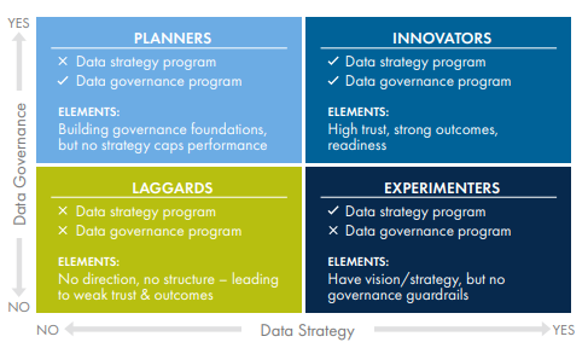
The research also highlights a clear pattern: organizations that combine a formal data strategy with data governance programs achieve the highest levels of trust and performance. In contrast, organizations with neither report no high trust in their data, underscoring the foundational role governance plays in AI success.
Specifically, organizations with both (“Innovators”) report 72% high trust in their data — versus 0% for those with neither. For CDOs making the investment case to the board, this is the evidence: strategy without governance produces uneven results, but governance without strategy stalls. Both are required, and the CDO is the executive accountable for ensuring they develop together.

Governance Will Define Scalable AI
AI innovation is accelerating, but trusted data remains crucial for scaling it successfully.
The CDOs best positioned to lead their organizations through AI scaling aren’t starting governance programs from scratch — they’re extending the ones already in place. They’re:
- Expanding data quality, lineage, and access controls to cover AI training data and model outputs
- Integrating AI governance into the CDO mandate before regulators require it.
- Using governance performance data like trust scores, quality metrics, and compliance posture to make the business case for continued investment.
See the governance maturity benchmarks and trust data for yourself.
Read the full 2026 State of Data Integrity and AI Readiness report for the full findings from over 500 global data and analytics leaders.