

Walking the halls at the Gartner Data & Analytics Summit in Orlando recently, one theme came through clearly: organizations have moved far past the question of whether they should invest in AI and AI agents. The conversation now is about how to operationalize AI safely and at scale.
Nearly every leader I spoke with was experimenting with AI agents or planning to introduce them into their enterprise workflows. But when the conversation turned to the data those agents would rely on, I noticed that confidence dropped quickly.
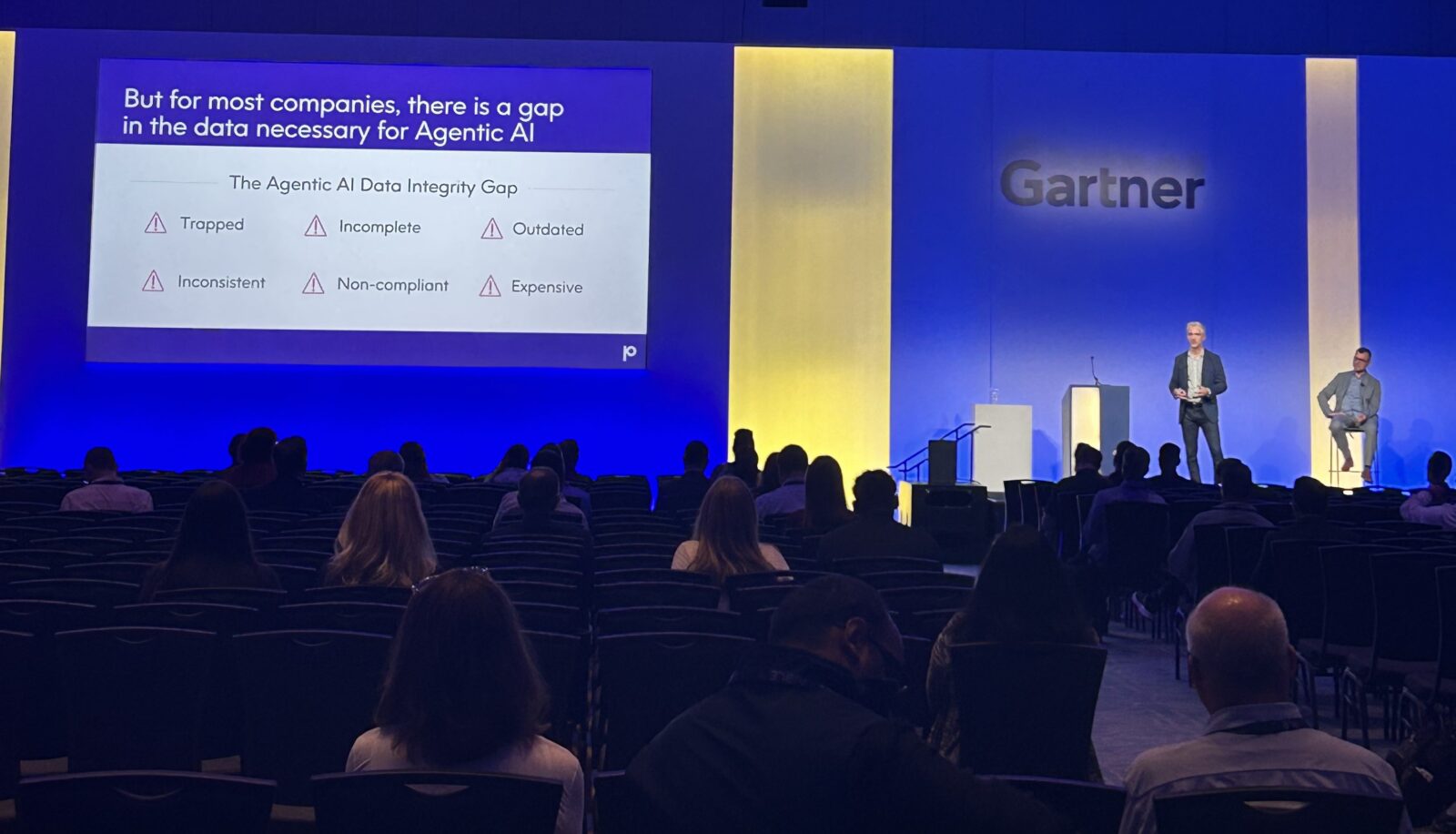
That gap between AI ambition and the reality of data readiness is something that Precisely calls the Agentic AI Data Integrity Gap. And it came up again and again in conversations with data leaders throughout the event.
The gap isn’t just anecdotal. Gartner estimates that as many as 70% of agentic AI use cases will fail due to weak data foundations, not because of the models themselves. It’s a clear signal that the bottleneck for AI success has shifted from algorithms to data.
Agents change the stakes for data trust. In the past, data trust often centered on analytics. If a dashboard was wrong, someone would notice and correct it. But with autonomous agents making decisions on behalf of people, the tolerance for uncertainty becomes much smaller. Organizations need much higher confidence that the data driving those decisions is complete, contextualized, governed, and current.
That’s the core idea behind Agentic-Ready Data: the highest-quality data that is integrated, governed, and enriched so AI agents and automated systems can act with confidence.
What We Heard on the Event Floor
Throughout the week, whether in our session, at the booth demos, or in hallway conversations, I kept hearing the same tension from organizations.
At a strategic level, many leaders feel confident about their AI roadmap. They’ve invested in cloud infrastructure, declared AI a priority, and launched initiatives across the business.
But when you talk with the teams closer to the data itself, a different picture often emerges. Questions surface quickly:
- How complete is this dataset?
- Does it have the right context for AI to interpret it?
- Can we trust it across systems?
- Is it governed and traceable?
Governance in particular was a major theme across the event. As AI adoption accelerates and metadata environments grow more complex, organizations are rethinking how governance is applied. Traditional data catalogs are increasingly seen as commodities. What matters now is how governance is operationalized and embedded into data workflows.
The disconnect between strategy and execution is one of the biggest barriers to scaling AI today.
The good news is that organizations are recognizing that resolving this disconnect requires closing the data integrity gap in their data foundation.
A Practical Framework from Entain
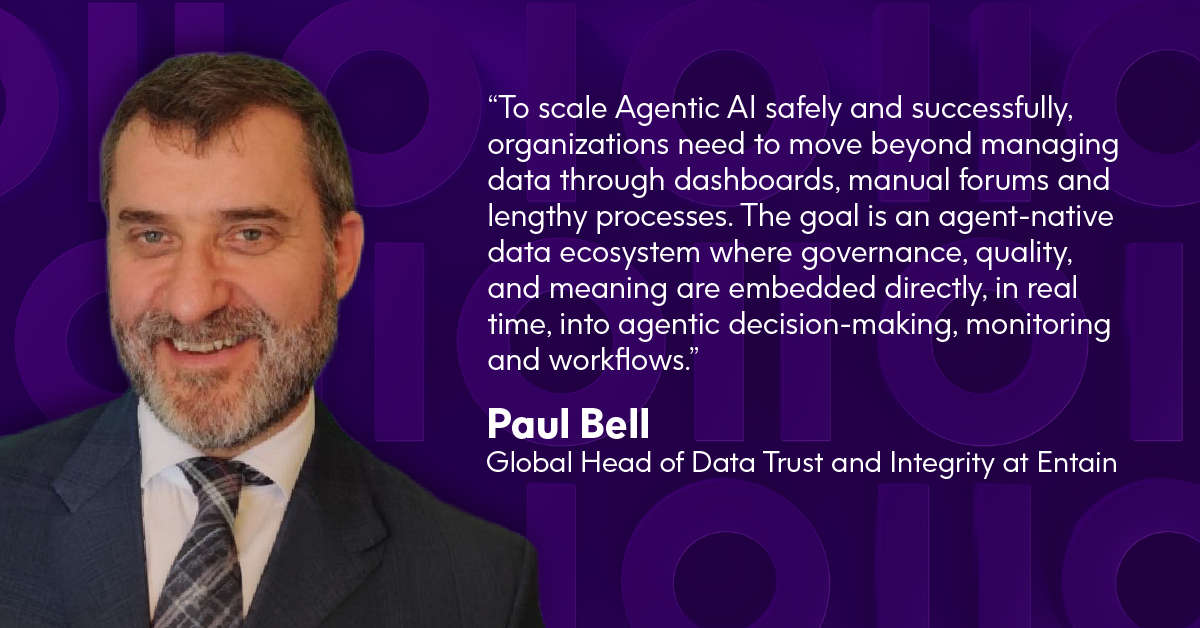
In our Gartner session, I presented with Paul Bell, Global Head of Data Trust & Integrity at Entain, one of the world’s largest global sports betting and gaming companies.
Operating across dozens of brands and markets, Entain manages highly regulated data at massive scale. Their experience offers a practical lens on how organizations can evolve their data ecosystem for AI.
Paul described a three-stage journey toward agentic AI readiness:
- Human-led
In the early stage, governance, quality, and semantic definitions are largely managed by people through processes, dashboards, and reviews. Data teams work to stabilize the data foundation, but governance is often retrospective and process-heavy. - Agent-assisted
The next phase introduces AI into the governance process itself. Governance signals, lineage, policies, and semantic context become structured so AI systems can understand and use them. Humans remain actively involved, supervising decisions and guiding policies. - Agent-native data ecosystem
The long-term destination is an ecosystem where governance, quality, and meaning are embedded directly into how data is used, rather than managed separately through manual processes. Policies are enforced dynamically at runtime, and AI agents can evaluate confidence levels and decide whether to act, pause, or escalate when uncertainty arises.
In this model, humans don’t disappear, but their role evolves. Instead of managing routine data decisions, they oversee outcomes, manage exceptions, and guide risk.
This progression toward structured, machine-consumable data is quickly becoming critical infrastructure. Gartner predicts that by 2028, 60% of agentic AI projects without a semantic layer will fail, highlighting how essential shared meaning and context are for AI agents to operate reliably at scale.
The Six Challenges Behind the Agentic AI Data Integrity Gap
Another takeaway from Gartner conversations is that the data challenges behind Agentic AI readiness are surprisingly consistent across industries, and they reinforce the conditions that create the Agentic AI Data Integrity Gap.
Organizations often struggle with data that’s:
- Trapped in silos and difficult to unify
- Incomplete and missing context needed for accurate AI results
- Out of date for real-time decisions
- Inconsistent across systems
- Non-compliant and lacking consistent data governance
- Expensive due to manual processes and specialized skills
Each of these issues makes it harder for AI agents to operate safely and effectively.
The path forward isn’t to solve everything at once. The most successful teams start with a specific use case, strengthen the data foundation around it, prove the value, and then replicate that pattern across their organization.
That means that data is unified, contextualized, fresh, complete, governed, and that the right cost structure supports it all.
Precisely Data Strategy Consulting
A comprehensive range of data strategy consulting options delivered by seasoned data experts, tailored to your specific requirements, and focused on delivering measurable outcomes and achieving your objectives.
Setting the Stage for an Agentic-Ready Future
What excited me most at Gartner was seeing how many organizations are actively working through this transition.
At the Precisely booth, our team was consistently running demos showing how organizations are using the Precisely Data Integrity Suite to strengthen their data foundations for the Agentic era: integrating, governing, and enriching data so AI initiatives can scale responsibly.
And across conversations with data leaders, one idea kept coming up: AI agents are moving quickly into the enterprise. But their success will depend entirely on the quality, governance, and context of the data behind them.
The future of AI in the enterprise will be decided at the data layer, not the model layer. The organizations that get there first won’t be the ones who moved fastest on agents. They’ll be the ones who built the foundation before the agents arrived.
For organizations earlier in that journey, defining a clear path to Agentic-Ready Data is often the first step, and one where the right strategy and expertise can make all the difference. Learn more about how Precisely can help.