Operational Resilience in the Age of Continuous Compliance
Eliminating Blind Spots Across mainframe, IBM i, and Modern IT Platforms
The New Reality of Operational Resilience
Regulations like DORA, NIS2, NYDFS, and SOX are raising the bar for operational resilience. It used to be that compliance was something you prepared for once a year, but today’s regulators expect continuous proof:
- Are your systems operating within defined risk thresholds?
- Are you able to detect and report incidents within hours?
- Does your visibility span every layer of your IT environment?
For many organizations, that last requirement is exactly where things start to fall apart.
The reality is that a significant portion of the world’s business-critical workloads still run on IBM mainframe and IBM i systems. Financial transactions, insurance records, government data, and healthcare claims power some of the most regulated operations on the planet — yet most modern IT operations and observability platforms don’t naturally see them.
So, what does it take to build genuine operational resilience in a hybrid IT world? Why has the mainframe visibility gap persisted for so long? And how can organizations in regulated industries finally close the gap, without ripping and replacing what works? Let’s dive in.
The Hidden Risk: Legacy Systems as Compliance Gaps
Why is mainframe visibility still a problem?
Mainframes are some of the most instrumented platforms on the planet. Every installed software product, version, and vendor all tracked authoritatively on the platform itself.
So why does the data stay trapped there?
The answer is less about the mainframe itself and more about the ecosystem around it. Modern IT operations platforms were built for cloud-first, distributed architectures. Mainframe telemetry is different: the job logs, system logs, and event data use formats and structures that these platforms simply weren’t designed to parse. There aren’t native connectors or plug-and-play integration.
“IBM i or IBM Z data doesn’t easily flow inside CMDB or other standard IT operation management workflows. A lot of companies end up relying on manual work, on-ground solutions, and IBM experts updating things by hand.”
Arosha Tomaselli
Senior Product Owner, Ironstream – Precisely
What fills the gap? Manual processes, spreadsheets, and periodic updates from a shrinking pool of mainframe specialists (updates that are already out of date by the time they’re completed).
This goes beyond operational inconvenience to a greater issue of trust. When your dashboards, CMDB, and compliance reports carry a quiet footnote that says “mainframe not included,” every downstream decision built on that data carries hidden uncertainty and every audit becomes a scramble.
The cost shows up across the organization:
- License audits that silently skip mainframe software
- Vulnerability programs that can’t see mainframe software versions
- Manual data exports that are stale the moment they’re produced
- Trust erosion as stakeholders notice the gaps
The result is a fragmented IT picture that creates direct compliance risk, and teams working in silos who can’t see the full scope of it.
The Compliance Shift: From Periodic to Continuous
Regulations like DORA and NIS2 don’t just want to know that your systems were compliant last quarter. They want evidence that your systems are operating within defined parameters right now, and that you can prove it on demand.
Incident reporting timelines have collapsed from days to hours. Asset inventories need to be current. And audit evidence can no longer be something you reconstruct under pressure; it has to be something your systems generate continuously.
What does continuous compliance require?
In practice, continuous compliance means your operational systems are doing the compliance work for you, automatically and in real time.
It means:
- Real-time telemetry delivery from every system in your environment, not just the ones that are easy to access
- Automated evidence collection, so a regulator’s question doesn’t trigger a manual fire drill
- Cross-platform visibility so that incidents, configurations, and changes are logged consistently, whether they originate in the cloud or on a mainframe
- Audit-ready reporting that can be produced instantly, not rebuilt over several days
Organizations still relying on manual processes to bridge this gap can’t realistically meet these requirements. The data doesn’t arrive fast enough, isn’t normalized consistently, and isn’t woven into the workflows where decisions get made.
The Cost of an Incomplete IT Picture
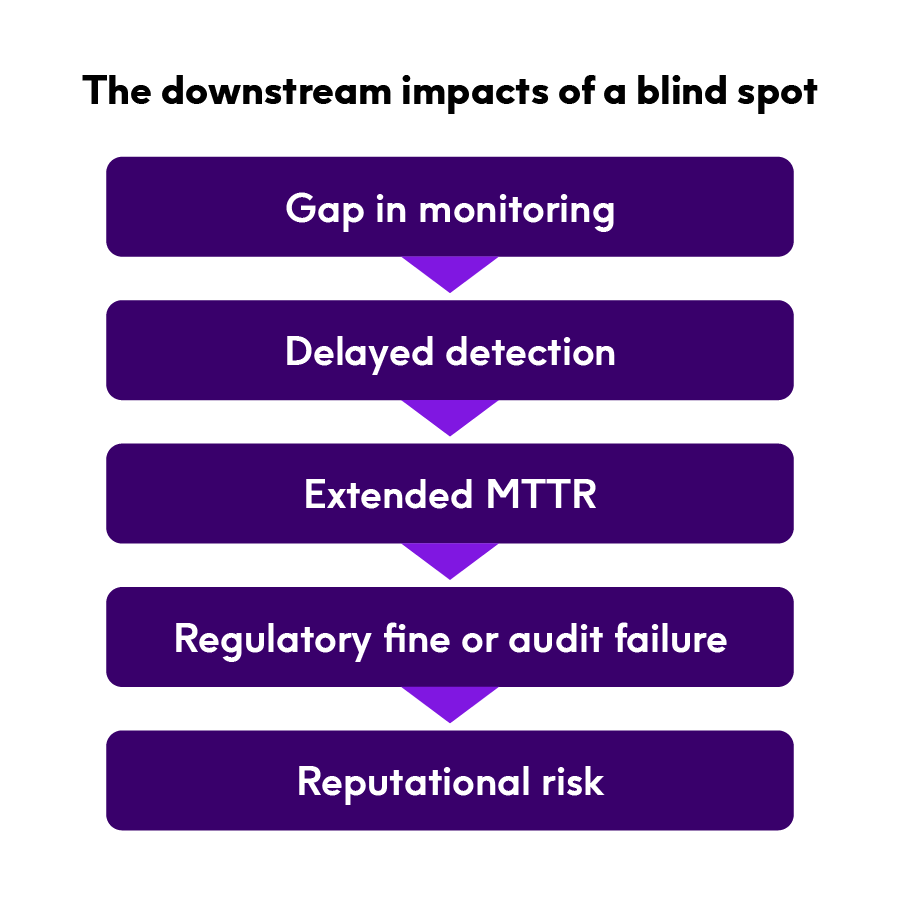
When an incident originates in a mainframe subsystem and your event management platform has no visibility into it, the clock starts running before your teams even know there’s a problem. By the time the impact surfaces in a system they can see, you’ve already lost time you can’t recover – and under DORA’s reporting requirements, that matters.
“It’s almost a mission impossible without real-time data streaming across the entire IT stack, to meet those requirements on a compliance and business perspective.”
Bowen Yang
Principal Product Manager, Ironstream – Precisely
The downstream effects compound quickly:
- Delayed or inaccurate regulatory reporting that puts you at risk of fines and regulatory intervention
- CMDB inaccuracy that undermines every workflow, report, and decision built on top of it
- Software asset management gaps that create undetected license compliance exposure
- Audit preparation that drains IT resources due to manual collection
- Reputational risk when regulators or customers discover that your monitoring doesn’t cover your most critical systems
The operational toll compounds, too: higher MTTR, teams stuck in reactive mode, and resources drained by siloed tools that should be working together.
What Operational Resilience Actually Requires
For organizations running hybrid IT environments, operational resilience rests on four capabilities that are harder to achieve than they sound:
Full-stack visibility across all systems, including IBM i and mainframe
Real-time
data delivery
Integration with the observability platforms and workflows your teams already use
Continuous
audit readiness
For organizations running mainframe or IBM i, all four have historically required significant manual effort, specialized expertise, or custom development to achieve. And even then, the results are often fragile and incomplete.
How do you measure operational resilience?
- Mean Time to Detection (MTTD) and Mean Time to Resolution (MTTR): how quickly your teams identify and resolve issues
- CMDB coverage and accuracy: the completeness of your configuration management database as the system of record
- Audit trail continuity: the availability of timestamped, cross-platform evidence for regulators
- Incident reporting velocity: your ability to meet tight notification windows required by DORA, NIS2, and NYDFS
Each of these degrades when a significant part of your IT environment is invisible to your operations and compliance workflows.
The Role of Modern Platforms
If you’re using modern platforms like ServiceNow for IT operations management, you already understand the value of a unified platform. But the challenge is that mainframe and IBM i data don’t naturally integrate.
Without those systems in the platform, your CMDB is incomplete, audit trails are weak, service maps have gaps, and your event management workflows are missing critical data.
Why does an incomplete CMDB matter so much?
The CMDB is the foundation on which nearly everything else in ServiceNow is built: change management, incident correlation, service impact analysis, compliance reporting.
When mainframe and IBM i assets aren’t in there, you’re not just missing records; you’re undermining the reliability of every process built on top of them. True end-to-end service mapping, the kind that enables accurate capacity management, impact analysis, and proactive risk assessment, is only possible with a complete picture.
Closing the Gap:
Integrating Legacy Systems into Modern Workflows
Closing the gap starts with automated, real-time integration: a purpose-built bridge that understands mainframe data natively, normalizes it into formats modern platforms can consume, and keeps everything synchronized continuously. Not point-in-time exports, manual specialist updates, or custom connectors requiring ongoing maintenance.
When that integration exists, your operational picture transforms:
- Service Mapping: Service maps extend to include mainframe dependencies, so you know exactly how a backend IBM system supports a customer-facing service — and what happens downstream when something changes.
- Event Management: Critical management messages and events from mainframe systems are forwarded to your event management platform for correlation, deduplication, and action, using the same AIOps workflows you already rely on.
- Software Discovery: Installed software on mainframe systems is automatically identified and synced to ServiceNow’s CMDB and Software Asset Management tables, giving SAM teams a complete, audit-ready inventory.
Key Use Cases
Incident Detection and Response
When mainframe and IBM i events are normalized into the same event management workflow as your cloud and distributed systems, operations teams can correlate alerts across the full stack and identify root causes that would otherwise stay hidden. Real-time data ingestion means issues surface while they’re happening – enabling faster triage and shorter MTTR.
CMDB Accuracy and Audit Readiness
Your CMDB is only as valuable as the data in it. Automated discovery and continuous synchronization of IBM Z and IBM i configuration items means your system of record always reflects reality. When auditors ask for evidence, you produce it instantly from a continuously updated source.
Regulatory Reporting
Continuous telemetry from mainframe systems means compliance monitoring is ongoing, not periodic. Under DORA’s 24-72 hour incident reporting requirements, organizations that can demonstrate real-time monitoring coverage across legacy and modern systems are in a fundamentally different position than those presenting manually assembled reports.
Risk and Impact Analysis
True service mapping — including mainframe dependencies — lets you understand risk in context. If a microservice is a critical dependency for an IBM subsystem, you can’t see that relationship until your service map actually includes the mainframe. With complete mapping, capacity planning, change management, and impact assessments become meaningful across the full stack.
Software Asset Management Workflows
Mainframe and IBM i systems are routinely excluded from SAM programs, creating gaps in license compliance, audit readiness, and cost visibility. When z/OS software is automatically identified and synced to ServiceNow’s CMDB and SAM tables continuously, SAM governance can extend across the full enterprise: license compliance validation, entitlement reviews without manual data pulls, and cost insights based on actual usage. Full operational resilience requires visibility into the software running on your most critical systems.
The Business Impact of Getting This Right
Closing the hybrid IT visibility gap changes how IT and operations teams work — not just how they report. Incidents that used to take hours to diagnose now surface in minutes. Evidence that used to require weeks of manual collection before a regulatory review is replaced by automated reporting from a continuously updated system of record. And compliance becomes something you can demonstrate in real time.
The result is faster MTTR, reduced audit burden, lower compliance risk, and stronger governance – across every layer of your infrastructure, including the ones that have historically been invisible.
What this means for your business:
- Faster MTTR
- Reduced audit burden
- Lower compliance risk
- Stronger governance
Getting Started: A Practical Path Forward
Here’s a practical framework for getting started:
Assess
Assess your visibility gaps. Map which systems are included in your current CMDB, event management, and SAM workflows. Identify where mainframe and IBM i environments are absent or represented only through manual processes.
Align
Align with your regulatory requirements. Review the specific obligations under DORA, NIS2, NYDFS, or other applicable regulations for incident reporting timelines, asset inventory scope, and audit trail requirements. Match those requirements against your current coverage.
Integrate
Integrate telemetry into a central platform. Bring mainframe and IBM i data into your IT operations and compliance workflows — Discovery, CMDB, Event Management, Software Discovery — so it’s part of the same system your teams already use.
Monitor
Monitor continuously. Move from periodic audits and manual evidence collection to automated, always-on visibility. Schedules, alerts, and reporting should keep your compliance posture current without requiring manual intervention.
For ServiceNow users, the fastest path starts with automated discovery, letting the platform identify, classify, and populate configuration items from mainframe and IBM i environments automatically.
From there, service mapping, event management, and software discovery progressively extend your operational view until your IBM systems are visible, managed, and governed with the same rigor as the rest of your environment.
The visibility gap in your IT environment is a compliance risk you can’t afford to ignore. Organizations that close it now are building an operational resilience posture that will hold up through whatever the next regulatory cycle brings.
Close the Visibility Gap
with Precisely Ironstream
Precisely Ironstream™ software is the leading solution for integrating mainframe and IBM i data into enterprise IT operations, security, and compliance platforms, including ServiceNow.
As the only Elite Build Partner solution for mainframe and IBM i integration, Ironstream for ServiceNow enables real-time streaming of configuration, event, and software data into ServiceNow Discovery, CMDB, Event Management, and Software Asset Management — eliminating blind spots and supporting continuous compliance without requiring mainframe expertise from your operations teams.
95%
reduction in manual tasks reported by Ironstream customers
100+
hours saved on data delivery for reporting projects
$200K
saved per year by removing manual processes
Learn more about Ironstream™ for ServiceNow®.