

Artificial intelligence has evolved from a side initiative to a force shaping enterprise data strategy in real time.
In our 2026 State of Data Integrity and AI Readiness report, published by Precisely in partnership with the Center for Applied AI and Business Analytics at Drexel University’s LeBow College of Business, more than half of data leaders (52%) say AI is the primary force influencing their data programs.
Predictive, generative, and Agentic AI are all moving quickly from experimentation to expectation. But beneath that momentum, leaders revealed two deeply connected realities:
- AI excitement is outpacing organizational readiness.
- Skill shortages remain one of the biggest barriers to scaling data, analytics, and AI.
These aren’t separate issues. They amplify each other, and if we don’t address them directly, they will undermine the very outcomes we expect AI to deliver.
This year’s data reveals a clear pattern: confidence is high, while preparedness is uneven. And the gap between the two is where risk lives.
The Confidence–Reality Disconnect in AI Readiness
On the surface, organizations appear ready.
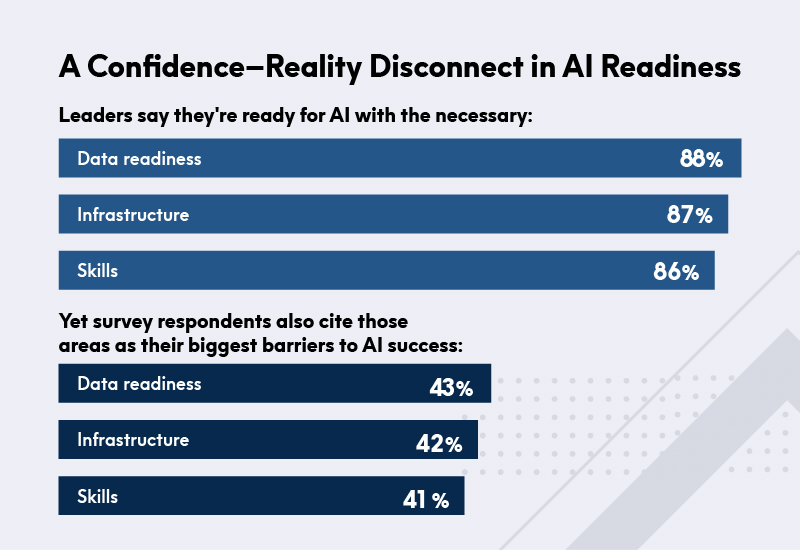
Eighty-eight percent of leaders say they have the necessary data readiness to support AI, 87% say they have the infrastructure, and 86% say they have the skills. Yet those same areas are also cited as their biggest obstacles to AI success: data readiness (43%), infrastructure (42%), and skills (41%). That’s a structural disconnect.
I call this measuring readiness at the wrong altitude.
At a strategic level, many organizations are ready. They’ve invested in platforms. They’ve launched pilots. They’ve secured budget. Overall, AI is aligned to business priorities (at least on paper).
In fact, 71% say AI aligns with business goals, but, only 31% have metrics tied to business KPIs like revenue growth, cost reduction, or customer satisfaction.
This is where the disconnect becomes visible.
Pilots succeed in controlled environments where data is curated, feedback loops are tight, and expectations are managed. But when AI moves into production – across functions, systems, and stakeholders – the underlying operational immaturity is exposed, often all at once.
Without measurable business alignment, prioritization becomes fuzzy. Funding becomes unstable. Promising prototypes stall before they become durable capabilities.
AI readiness ultimately depends on sustaining outcomes repeatedly and at scale.
Skills: The Hidden Multiplier (and Risk Amplifier)
The skills gap is another major theme in this year’s report – and the issue is more complex than a hiring shortage.
More than half of leaders (51%) cite skills as their top need for AI readiness, yet only 38% feel prepared with the appropriate staff skills and training.
Here’s what’s important: no single skill gap dominates.
- 30% say they lack the ability to deploy AI at scale in a business environment
- 29% cite a lack of expertise in responsible AI and compliance
- 28% struggle to translate business needs into AI solutions
- 27% say AI model development and basic AI literacy are challenges
- 26% cite “multiple other needs,” for skill sets – including bridging technical and business teams, translating AI findings into actionable strategies, and understanding business processes.
“The skills gap isn’t about a lack of talent in one area, it’s about the need for professionals who can operate across data, business strategy, and AI governance simultaneously. That reality has major implications for how organizations and universities prepare those entering the workforce for the era of Agentic AI.”
– Murugan Anandarajan, PhD, Professor and Academic Director at Drexel LeBow’s Center for Applied AI and Business Analytics.
The challenge is systemic, reflecting how interconnected the capabilities behind enterprise AI truly are. Scaling AI requires a broad array of skill sets working together across the organization, including:
- Data engineers
- ML engineers
- Governance architects
- Observability specialists
- Domain translators
- Leaders who can tie outcomes to strategy
And one of the most underestimated skills is the ability to connect business intent to technical implementation and explain AI outcomes in terms executives can act on, not just admire.
Without translation of AI to business outcomes, models operate in isolation.
Without governance, risks compound.
Without measurement, ROI remains aspirational.
REPORT2026 State of Data Integrity and AI Readiness
Findings from a survey of global data and analytics leaders.
The data also shows a progression in how organizations can close the gap between AI readiness and business outcomes – and this depends heavily on alignment between readiness and goals:
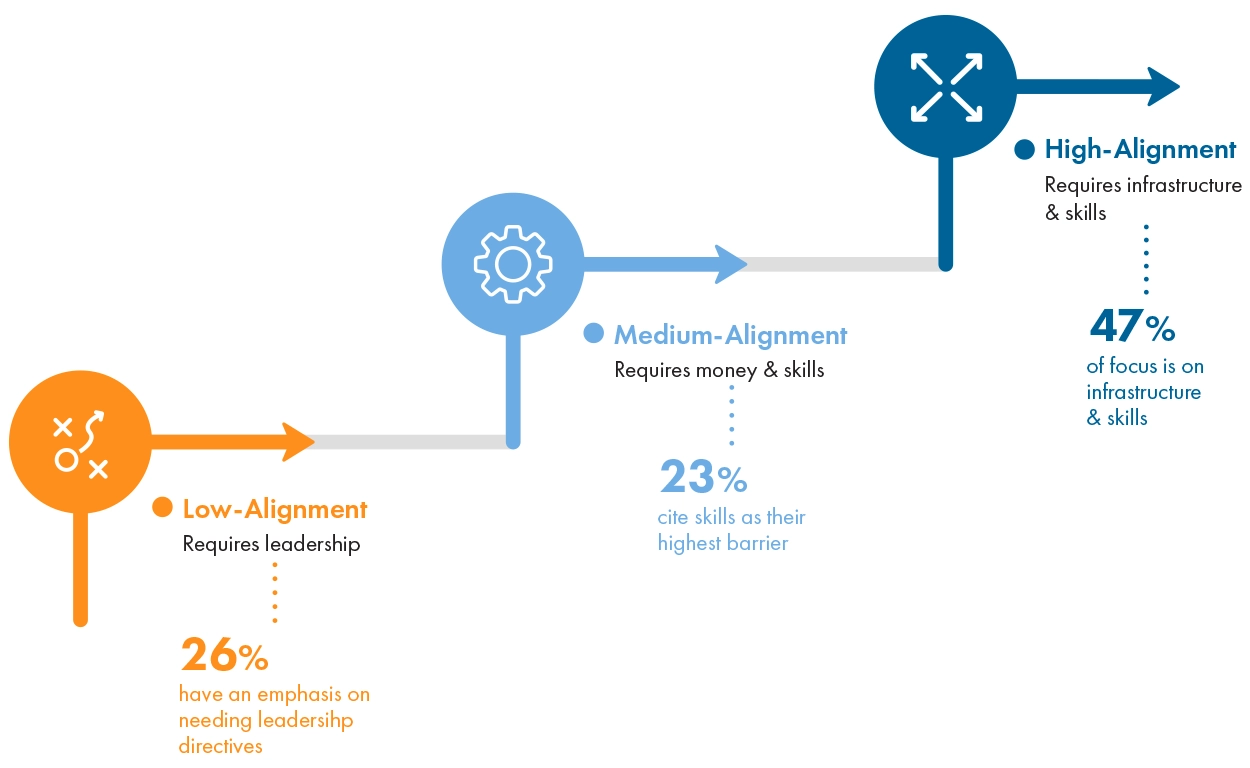
Organizations with low AI alignment need leadership direction
For organizations rating “not at all” or “not well” in achieving their objectives, the challenge is less about tools or talent and more about clarity.
Leaders often assume gaps in infrastructure (23%) or skills (25%) are the root issue, but the data shows a lack of executive direction and alignment is what stalls progress. Without a clear mandate, investments in AI remain fragmented and struggle to gain traction.
Mid-tier performers need investment and skills
Organizations in this middle stage – those achieving their AI goals “somewhat” – tend to understand what success looks like, but lack the resources to execute.
The report shows they most commonly cite financial investment (22%) and skills (23%) as their biggest barriers. At this stage, progress depends on building both the technical capabilities and the workforce needed to operationalize AI across the business.
High performers continue strengthening infrastructure and skills to scale
For organizations already achieving strong alignment – rating their goal achievement “well” or “very well” – the focus shifts from initiation to scale.
These teams have established direction and early success, but sustaining momentum requires continuously evolving both infrastructure and skills. Even at this level, nearly half of focus remains on strengthening these capabilities – highlighting that AI maturity is not a finish line, but an ongoing discipline.
It’s critical to remember that AI maturity is iterative, requiring continuous recalibration as technology and expectations evolve. Organizations that close skills gaps across engineering, responsible AI, and business translation are significantly more likely to move from experimentation to sustainable AI scale.
From Momentum to Maturity
Perhaps the most revealing data point is around optimism. Thirty-two percent of leaders expect positive ROI from AI in the next six to eleven months – despite persistent gaps in governance, skills, and measurement.
Optimism isn’t wrong. But optimism without operational foundations becomes fragile, particularly when expectations are high, and scrutiny is increasing.
Achieving AI readiness requires an integrated operating model that unifies:
- An AI-ready data foundation, including data quality, governance, context and enrichment, and measurement and observability
- Skills development
- Business alignment
When these elements move together, confidence and reality converge. When they don’t, AI remains stuck in pilot mode – impressive, but not transformative; visible, but not durable.
As data leaders, our role is more than championing innovation. It’s to build durability, ensuring that early wins translate into sustained enterprise value.
If you take one lesson from this year’s findings, let it be this: AI readiness isn’t purchased. It’s earned, through consistency, capability, and trust. And operational capabilities demand discipline, not just ambition.
Closing the Gap Before It Widens
The window for honest assessment is now.
AI ambition is real and influencing data programs across industries. The investment is significant. The opportunity is enormous. But so is the risk of overestimating readiness, particularly when early momentum masks deeper structural gaps.
The organizations that win in 2026 won’t be the ones that move fastest into AI experimentation. They’ll be the ones that invest in the fundamentals – including robust data governance, data quality measurement, and talent development – to achieve the most from AI.
I encourage you to explore the full 2026 State of Data Integrity and AI Readiness report to examine where confidence and operational reality may be drifting apart in your organization – and where strengthening your foundations today can unlock more scalable, sustainable AI outcomes tomorrow.