


Key Takeaways
- Organizations with formal data governance programs are 21% more likely to report high trust in their data than those without one. This is a critical disconnect when AI is in the picture.
- The highest-performing organizations aren’t running data strategy and data governance as separate tracks; they’re running them together, and that alignment is what separates durable AI programs from expensive pilots.
- AI governance isn’t a new discipline to build from scratch. For most organizations, the smartest path forward is extending what they already have into an integrated framework.
Three decades in data and analytics teaches you to recognize a pattern when you see one.
And the pattern I keep seeing, whether I’m talking to chief data officers at global enterprises or reviewing the findings from our 2026 State of Data Integrity and AI Readiness report, is that the organizations getting the most out of AI aren’t necessarily the ones who invested the most in AI. They’re the ones who invested in the right foundation first.
Data governance is critical to that foundation. And what this year’s survey of over 500 data and analytics leaders makes clear is how dramatically the stakes have changed. As organizations push deeper into AI adoption, data governance for AI readiness has become one of the most consequential investments a data leader can make.
Why Data Governance Is Now a Business-Critical Function
For a long time, data governance was largely a compliance story. Financial services organizations governed their data because they had to. Healthcare did the same. The rest of the enterprise treated it as an IT initiative: useful in theory, easy to deprioritize in practice.
That’s changed and AI is what changed it.
The leaders in this year’s survey were direct about it:
- 42% cited improved AI readiness as a top value their governance program delivers
- 39% pointed to improved quality of AI outcomes as a direct benefit.
That’s governance doing exactly what it’s built to do. And the timing couldn’t be more critical as AI raises the stakes higher than ever.
When you feed a model bad data or ungoverned data, all you get is a confidently mediocre output. That’s the distinction that makes all the difference in an agentic environment, where systems are making or informing decisions with limited human review.
The model doesn’t flag its uncertainty the way an experienced analyst would. It optimizes within whatever constraints it’s been given and produces something that looks authoritative, even when it’s built on a flawed foundation.
The 2026 report reflects this shift clearly. Eighty-three percent of organizations now have an ongoing governance program — and the ones that do report high trust in their data at a rate of 71%, compared to just 50% for those without one. That 21-point gap was notable in a world where humans were the primary consumers of that data. In a world where AI agents are acting on it, think of it as your risk exposure.
What I find most interesting is where that trust disconnect comes from. It’s not that ungoverned organizations have terrible data. It’s that they have unverifiable data.
The experienced analyst who knows the quirks of a particular dataset and compensates accordingly still exists, but the AI agent doesn’t have their instincts. And if you’re scaling Agentic AI across your enterprise, you can’t build a production system around compensating instincts that don’t transfer.
Governance is what makes data trustworthy for systems that can’t exercise judgment on their own.
Why Data Strategy and Governance Must Move Together
One of the more important findings in this year’s report is the way it segments organizations into four distinct profiles based on two factors: whether they have a clear data strategy and whether they have a formal governance program in place.
- Innovators: these organizations have both, and 72% report high trust in their data
- Planners: those with governance but no strategy come in at 40% high trust
- Experimenters: organizations with strategy but no governance reach 61%
- Laggards: those with neither, reporting 0% high trust, with 73% stuck at average performance
What that tells me is that strategy and governance are complementary, not interchangeable. You can have a well-documented data strategy and still produce inconsistent results without governance mechanisms to enforce accountability. You can have a governance program and still focus on the wrong things if it isn’t connected to business objectives. The only path to that upper-right quadrant — the Innovator position — is to bring both together.
I speak with CDOs every week, and what I consistently see is organizations trying to improve their governance without a clear strategy, or building out their data strategy without governance embedded as part of it.
Both approaches produce partial results. When I’ve seen organizations build programs that genuinely accelerate AI outcomes, it’s because they started with business goals (not data goals) and worked backward from there.
Governance
✓ Data governance program
✓ Data governance program
Governance
✕ Data governance program
✕ Data governance program
Many organizations built solid governance programs over the past several years, and these programs were genuinely fit for purpose in a world of analytics and reporting. Now they’re asking those same programs to support Agentic AI, where the requirements around context, lineage, and data quality are substantially higher.
It’s not that what they built was wrong. It’s that AI has raised the bar for what “ready” truly means.
How Should Organizations Approach AI Governance — Extend or Build Separately?
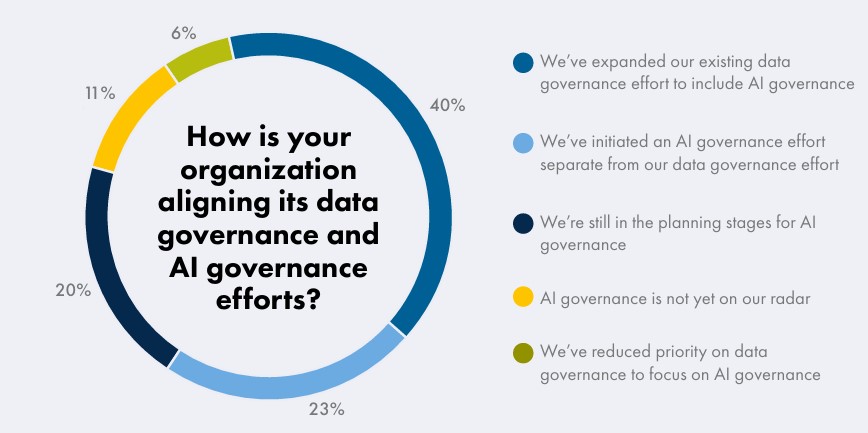
This is probably the question I get most often right now, and the survey data reflects just how actively organizations are wrestling with it.
- 40% (the largest group) are extending their existing data governance programs to include AI governance.
- 23% have built separate AI governance programs.
- The rest are still in planning or haven’t started.
For most organizations, extension is the smarter starting point, provided the existing governance framework is mature enough to build from.
Here’s the logic: if your current governance program has solid lineage documentation, quality rules, and clear data ownership, those are exactly the things AI needs. That means you don’t need to start from scratch, but simply adapt what you already have.
The unique consideration that AI adds is what I’d call the “should we” question: not just whether a use case is technically feasible, but whether the data is of sufficient quality for an AI system to act on it, and whether doing so aligns with your organization’s values, ethics, and regulatory obligations. That requires bringing new voices into the governance conversation, like legal, HR, ethics, and security, who may not have been central to traditional governance programs.
What doesn’t work is treating AI governance as a separate workstream that operates independently of data governance. The data piece and the AI piece can’t be managed in isolation; they’re dependent on each other.
What I see again and again in client conversations is organizations that spent the past 18 months investing heavily in AI compute and infrastructure without addressing the data governance piece, and they’re now hitting that wall.
Use cases that looked promising in a controlled environment don’t scale into production. Models produce inconsistent outputs. Programs that started with real momentum can’t make the transition from pilot to something durable.
Build AI-Readiness with Data Governance
There’s a useful way to think about where your organization sits on this curve: ask whether your governance program is producing outcomes the business can articulate, or whether it’s still operating as a technical compliance function that’s largely invisible to business leadership.
Organizations that have made the shift from the latter to the former — programs that are embedded in business processes, tied to measurable outcomes, and governed by people who can connect data decisions to business priorities — are the ones that are going to be positioned to move quickly as Agentic AI matures.
Organizations that are still building governance as an adjunct to the business, something you go ask for approval rather than something that’s woven into how decisions get made, are going to struggle.
The 2026 report found that organizations with governance programs in place achieve meaningfully better results across:
- Operational efficiency (19% improvement)
- Revenue generation (16%)
- Modernization (15%)
- Regulatory compliance (13%).
Those are direct outputs of having data that people, and increasingly, AI systems, can actually trust. And they’re improvements in the outcomes executives actually care about, which makes governance both a data and business initiative.
Explore the full 2026 State of Data Integrity and AI Readiness report, developed by Precisely in partnership with Drexel University’s LeBow College of Business, to assess where your organization’s governance foundation stands — and what strengthening it could unlock for your AI program.