


Key Takeaways
- 96% of organizations are already investing in location intelligence and third-party data enrichment, but near-universal adoption does not equal maturity
- AI amplifies the consequences of incomplete or ungoverned context data – confidently wrong outputs are far more dangerous than mediocre ones.
- The question for data leaders has moved past “are we using enrichment?” to “is it governed, fresh, integrated, and truly AI-ready?”
Here’s one thing I’ve learned after three decades in location data: nearly every organization has had a version of the same blind spot.
They invest heavily in understanding their own operations – transactions, interactions, customer records – and they get quite good at it. What they systematically underinvest in is understanding the world those customers and assets exist in:
- The neighborhood that’s changing
- The competitor that just opened nearby
- The infrastructure risk that didn’t show up in the last underwriting cycle
That’s the problem that location intelligence and third-party data enrichment are built to solve.
And according to the 2026 State of Data Integrity and AI Readiness report, developed by Precisely in partnership with Drexel University’s LeBow College of Business, most organizations have recognized this.
In fact, 96% of the data and analytics leaders surveyed say their organizations are already investing in some form of location intelligence and third-party enrichment. That’s as close to consensus as you see in enterprise research like this.
The headline isn’t that organizations need to start investing in context data. Most already are. The more important story, and the one that data leaders should pay attention to right now, is what separates the organizations getting genuine value from this investment from those that are just checking the box.
The Cost of Incomplete Context Has Changed
Organizations have historically used location intelligence and third-party data enrichment to correct for what their internal records can’t tell them:
- A property database that doesn’t reflect flood exposure leads to mispriced risk
- A site selection model that ignores traffic flow and competitor proximity leads to underperforming locations
- A delivery network built without accurate address and routing data leads to failed fulfillment and customer attrition
These are real, expensive consequences and they’ve been the argument for contextualized data for as long as I’ve been doing this work.
What AI changes is the error profile. When an experienced analyst is working with incomplete contextual data, they usually know it. They’ll flag the assumption, widen the range, or go find more information before committing a recommendation. That instinct to sense the edges of what you know is something humans develop over time and apply without thinking about it.
AI systems don’t have that instinct. A model operating on incomplete or ungoverned context won’t hedge; it will optimize confidently within the constraints it’s been given.
That’s fine when the data is solid. When it isn’t, you get outputs that look authoritative but are built on a flawed foundation. And in an agentic environment, where systems are making decisions with limited human review in the loop, there may not be a person positioned to catch the error before it propagates.
That shift from “analyst uses imperfect data and compensates” to “agent uses imperfect data and doesn’t” is what makes the quality of context data a fundamentally different kind of problem than it was five years ago.
What 96% Adoption Looks Like
The survey shows that organizations are applying location intelligence across a variety of use cases, including:
- Targeted marketing (41%)
- Address validation and standardization (41%)
- Delivery optimization (40%)
- Risk assessment and claims processing (39%)
When it comes to data enrichment, the top types of third-party data include:
- Customer segmentation and audience data (44%)
- Administrative, community, and industry boundaries (39%)
- Consumer demographics (38%)
- Address and property details (35%)
- Natural risks and hazards (35%)
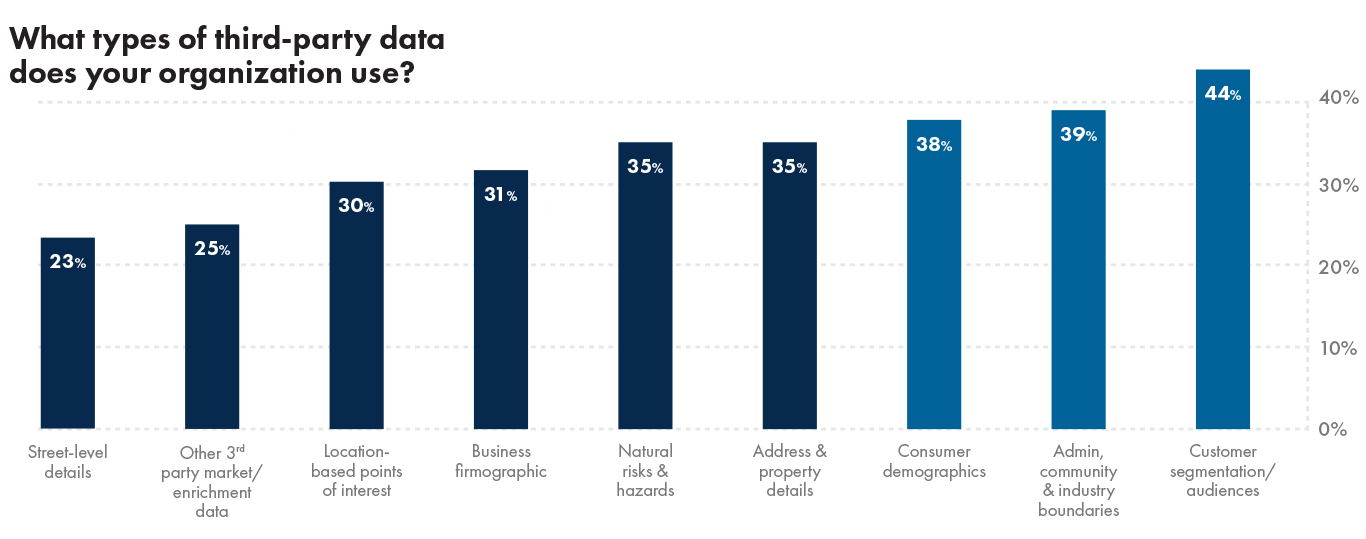
What this tells me is that the value proposition for contextual understanding has been validated across a lot of different business functions and industries. Insurance, retail, logistics, financial services … each found their own reasons to invest in location intelligence and data enrichment, and most of those investments are now embedded in core workflows rather than sitting in an analytics silo.
The harder question the report surfaces is how well those embedded investments are actually managed.
The Biggest Challenges in Location Intelligence and Data Enrichment
The report is transparent about what’s getting in the way of organizations extracting full value from these investments.
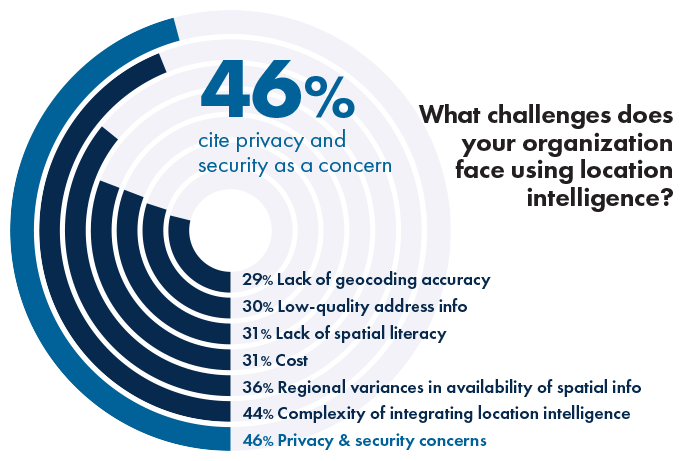
For location intelligence users, the top challenges are privacy and security concerns (46%), followed by the complexity of integrating spatial data into existing systems (44%).
For third-party data enrichment more broadly, data quality is the leading challenge (37%), trailed by data privacy and ethics (33%), regulatory compliance (32%), and compatibility with existing data and systems (31%).
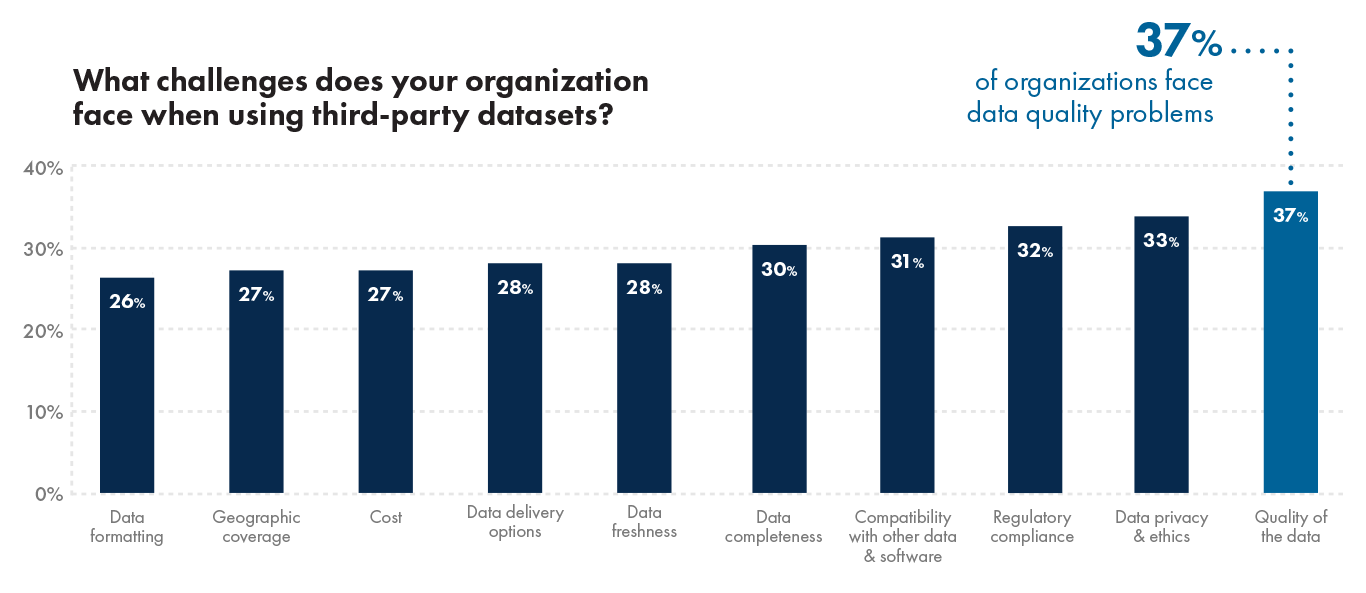
None of these are new problems. Integration complexity, data quality gaps, and privacy considerations have been friction points in enrichment programs for years. What’s shifted is how much these friction points cost you.
Before AI, an organization could have enrichment data that was reasonably good, periodically updated, and loosely integrated with other systems – and still get meaningful value from it. Analysts could fill in the gaps, recognize when something looked off, and exercise judgment. The data didn’t need to be pristine because the humans using it weren’t.
AI systems require different standards. Agentic workflows that make decisions autonomously need context data that’s:
- Integrated cleanly enough to query across
- Governed well enough to trust
- Fresh enough to reflect actual conditions
- Structured in a way the model can actually use – not designed for GIS specialists but never translated for machine consumption
Falling short on any of those dimensions introduces risk that compounds with every automated decision.
REPORT2026 State of Data Integrity and AI Readiness
Findings from a survey of global data and analytics leaders.
A Diagnostic for Data Leaders: Moving from Access to AI Readiness
Real-World Context Is Your Competitive Edge
One of the things the 96% adoption figure can obscure is that having location intelligence and enrichment data in your environment isn’t the same as being ready to use it for AI. This distinction matters a lot right now, because many organizations are at a point where they’ve made the investment in external data but haven’t rigorously examined whether that investment is truly AI-ready.
Here’s a practical way to think about it. Ask yourself: “If one of my AI systems needed to act on my location intelligence or third-party enrichment data right now, without a person in the loop to sanity-check the output, how confident would I be?”
That confidence depends on whether you can honestly answer yes to a set of questions that go well beyond “do we have the data?”:
- Is your enrichment data connected to the rest of your data environment in a way that’s clean and queryable, or does it live in a silo that requires manual joins to be useful?
- Does it have clear lineage and ownership, so you know where it came from, when it was last validated, and who’s accountable for its accuracy?
- Is it fresh enough to be reliable? Enrichment data that’s a year old may be fine for a retrospective analysis. For an agent making underwriting or delivery decisions in real time, it’s a liability.
- Is it expressed in a way that AI systems can interpret and reason over, or does it require a domain expert to translate what the attributes actually mean?
Leverage Real-World Contextual Understanding for Maximum AI Value
Most data leaders reading this have already made the investment in location intelligence and third-party data enrichment. That’s great news. The work now is making sure that investment is governed, integrated, and fresh enough to do what AI actually needs it to do.
Successful organizations will treat external data with the same rigor they apply to their core enterprise data – with clear ownership, active maintenance, and the governance to back it up. That’s what turns a data investment into a genuine AI advantage.
Read the full 2026 State of Data Integrity and AI Readiness report for more on how strengthening contextual understanding can maximize value from your AI initiatives.