
DATA GOVERNANCE AND QUALITY
Data governance solutions
Establish a strong, AI-powered data governance framework for your unique use cases to proactively find, understand, and manage data for proven business outcomes based on trusted data.
Find, understand and trust your data
Your organization has access to more data than ever. But to truly leverage its value, you need confidence in its quality, lineage, and meaning. Many organizations still struggle to know what data they have, where it lives, or what’s been done with it. Without that visibility, you risk compliance failures under expanding data privacy regulations like GDPR, and you leave real business value on the table. As business and IT teams work more closely together, governance solutions must connect data quality, data integration, data catalogs, and metadata management to support confident, data-driven decisions.
And as AI use cases multiply, the stakes grow higher. Without strong governance over the data fueling AI models — and the models themselves — organizations risk unreliable outputs, compliance violations, and unintended bias. As AI regulations evolve, transparency, accountability, and oversight aren’t just best practices—they’re essential for staying compliant and building trusted AI.
Resources
Empowering business users through Data & Analytics Governance
Effective data and analytics governance is crucial for harnessing the full potential of your data assets. But it presents unique challenges — particularly in empowering business users with the tools and understanding necessary to leverage data efficiently and responsibly.
A business-friendly, flexible data governance framework enables your business users to:
- Easily understand metadata
- Associate the policies governing their usage
- Know the procedures for gaining access
- Use AI and automation to boost productivity
- Automatically identify and tag personally identifiable information (PII) and critical data elements (CDEs) for stronger compliance
- Auto-generate clear, consistent asset descriptions to make data easier to find, understand, and trust
This level of transparency fosters a culture of data literacy and compliance across your organization — ensuring data insights are timely, relevant, and actionable. An intuitive data catalog is also vital for users to quickly identify and understand existing data assets, including technical metadata, data quality, and lineage. The Data Product Marketplace extends these capabilities, enabling teams to publish and share that governed data as certified data products — making it easy to find, trust, and use across teams, partners, and ecosystems. Then, you can move forward with better, more confident decision-making and greater operational efficiency.


Precisely Achieves FedRAMP® Certification
for its Data Integrity Suite Data Governance Service
Read the press release to learn more about the Data Integrity Suite for Government.
Harnessing the Power of AI Starts with Data Governance
AI innovation is moving faster than most organizations can manage — and that creates risk. As models multiply across teams and business functions, visibility declines, oversight weakens, and accountability becomes blurred. Without structure, organizations face model sprawl, inconsistent risk assessments, and uncertainty around how models are performing or being used — threatening compliance with emerging regulations like the EU AI Act and undermining trust in AI-driven decisions.
An effective AI governance framework brings order to this complexity. It creates a single, transparent system for managing models across their lifecycle — training, validation, deployment, and monitoring — while defining ownership, enforcing standardized approval workflows, and providing traceability for every model decision. With the right solution, organizations can unify model oversight, compliance, and data quality in one scalable platform — providing centralized visibility and integrated audit trails to keep models accountable and the organization compliant. And with MCP-enabled access, AI agents and enterprise workflows can access governed data directly, making it easier to build and scale AI applications on a foundation of trusted, auditable data.


Business-friendly data governance and stewardship
A business-friendly approach to data governance helps engage users across the organization and accommodate diverse use cases spanning analytics, operational improvements, regulatory compliance, AI governance, and risk management. Modern data governance solutions jumpstart this alignment with an intuitive and easily understood framework — or metamodel — that mirrors your business model to increase familiarity and facilitate adoption. Semantic tagging enables users to search in natural language and surface related assets automatically. Over time, these tags build a semantic layer — a shared vocabulary of consistent business definitions that ensures teams across the organization understand and use data the same way.
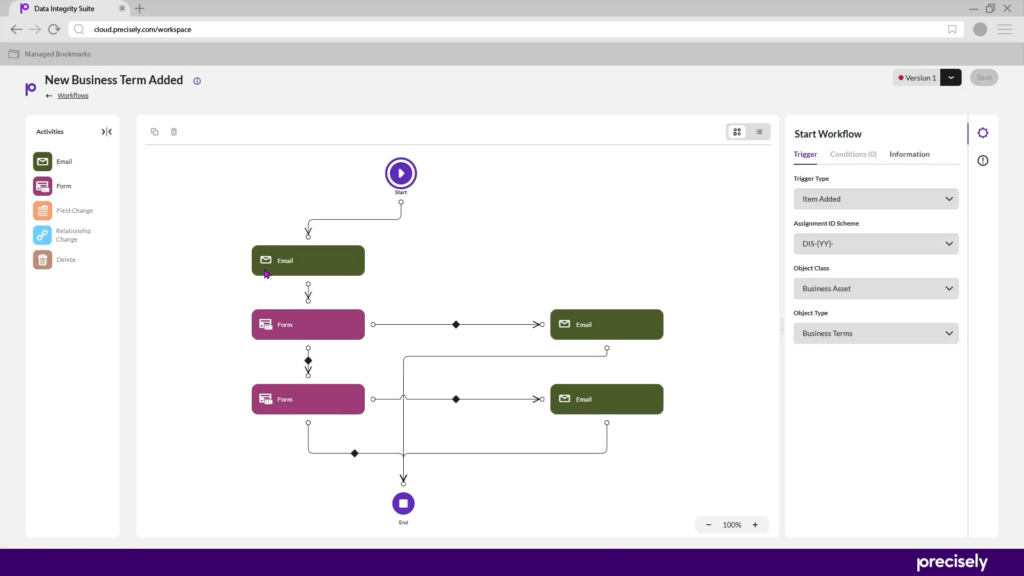
These solutions provide dynamic visualizations for lineage and impact analysis— giving users greater context and improving confidence in data-driven decisions. Data stewardship tools empower stewards to document, oversee, and enforce governance policies without deep technical expertise, with automated workflows for approvals, policy tracking, and AI-powered recommendations ensuring compliance at scale.
Automation also contributes to increasing data literacy and delivering solutions that are truly business-friendly. Your data governance solution should be able to quickly crawl, profile, and score complex metadata while providing accelerators to automate metadata ingestion — leveraging active metadata to keep your data catalog current, governed, and responsive to change. Precisely’s Data Governance and Catalog agents enhance this automation by identifying and tagging personally identifiable information (PII) and critical data elements (CDEs) automatically, enabling quicker, more consistent governance across the enterprise.
Complete your data governance initiatives with robust data quality
Data quality and data governance share a symbiotic relationship both working together to ensure data is accurate, consistent, and reliable for better business outcomes. A key goal of many data governance programs is to increase visibility into data quality so organizations can trust the data driving their decisions.
The right data quality tools go beyond cleaning raw data — they identify errors, enforce standards, and continuously monitor quality over time. With scalable remediation workflows, AI-driven recommendations, and real-time quality scores on key assets, organizations can proactively detect, flag, and resolve issues at scale —helping teams resolve issues faster, work more efficiently, and make more confident decisions.


Establish a value-based strategy for data governance
Proving the value of your data governance program should be an ongoing strategic practice. Without clear metrics connecting governance to business goals, critical processes, and transformational initiatives, your program risks losing sponsorship and funding. A value-based approach reframes governance not as a compliance obligation, but as a strategic program with measurable outcomes.
While the right products are essential, the people and processes that support them must be aligned. Precisely’s data strategy consulting team brings proven methodology to help you define, implement, and measure your governance initiatives — so you can build a sustainable, repeatable strategy that delivers real, documented business value.
Precisely Data Integrity Data Governance service: A more holistic framework
Precisely Data Governance service unifies a flexible metamodel, AI-driven automation, integrated data quality, and FedRAMP® certification in a single, business-friendly platform built to increase data literacy, reduce compliance risk, and deliver measurable business value. With expert advisory services to help you define, implement, and measure your program, Precisely is committed to delivering both trusted solutions and outcomes you can prove.

Ashland Inc.
Many of today’s large modern enterprises rely on successful mergers, acquisitions and divestitures as a significant part of their growth strategy, and Ashland Inc. is no exception. Their people, processes and systems are constantly moving and changing, which has made it increasingly challenging to remain innovative and agile in their quest for digital transformation.
“We had a lot of well documented business rules, but they were in a format that was consumable by the master data team, only. They were full of acronyms and ‘techy’ terms and lacked context around the business reason to have the rule”
Gred Hill
Global Master Data Manager, Ashland Inc.