

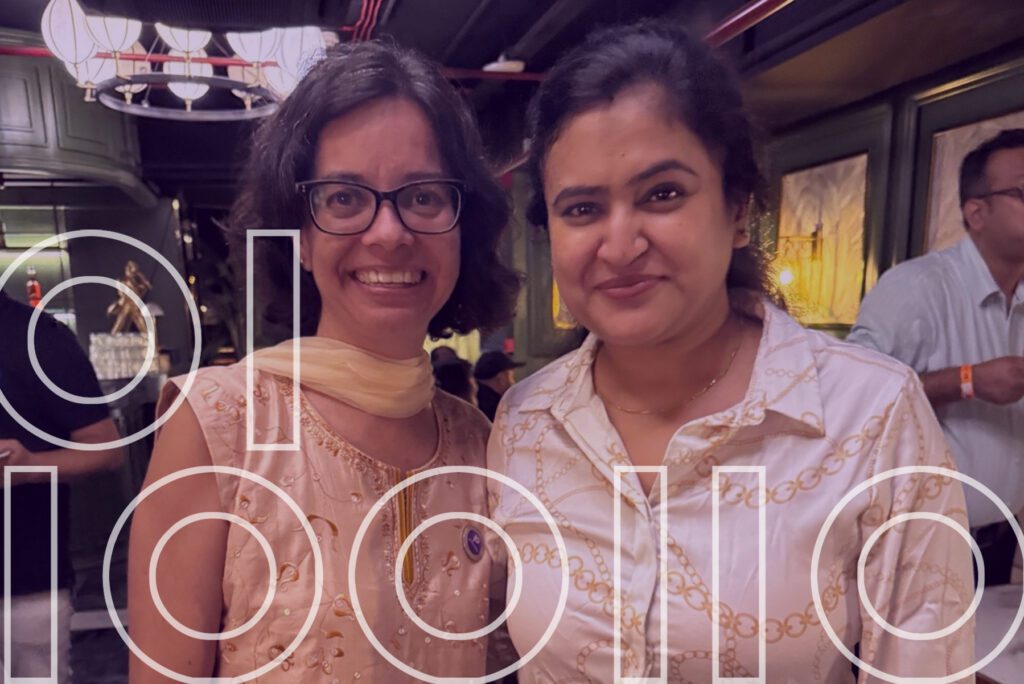
A career in technology can take many paths when it’s shaped by curiosity, bold decisions, and a willingness to solve meaningful problems. In the Precisely Women in Technology (PWIT) series, we celebrate the women across our organization who are building impactful careers while helping others do the same. In our latest spotlight, meet Aakansha Bhalotia, Principal Product Manager, whose 13-year career has taken her from building ERP systems to leading strategy and go-to-market for Precisely Platform and AI products. Continue reading to learn more about Aakansha and her career journey.
Why did you choose to pursue a career in technology?
I’ve always been drawn to numbers and because mathematics was my favorite subject in school, engineering felt like a natural path. But the real pull into technology came from helping my father run his business. I used to help him with billing, tallying, and a custom order management process that tracked raw materials coming in and revenue going out. When he expanded, replicating that model manually every month was exhausting and made me wonder: ‘What if there was a way to bring all of this together?’
That instinct led me to start my career building ERP systems, where I saw firsthand how fixing a messy data pipeline could save people hours of manual work every week. Over 13 years, I realized the hardest, most valuable problem isn’t the ‘how’ of building – it’s the ‘what’ and the ‘why’. What problem is worth solving, and what ideas should stay ideas? Today, I lead strategy, build, and go-to-market for the Precisely B2B SaaS platform products, across the Foundations and AI space. The scale has changed, but the core instinct hasn’t: find the friction, remove it, and solve practical customer problems.
Who has been your greatest professional mentor? What’s one thing you have learned from them?
I’ve been fortunate to learn from great teachers, professors, and managers throughout my career. But if I’m honest, the people who shaped my trajectory most weren’t traditional mentors. They were executive sponsors who modeled what high-trust, high-autonomy product leadership looks like, alongside the peer community I found at ProductTank Pittsburgh when I first transitioned into Product Management in the US.
My peers in Pittsburgh gave me a safe room to pressure-test messy ideas with like-minded builders, while my executive sponsors advised me to bring a clear recommendation and evidence, not just a problem. When the path is ambiguous, build something tangible, show how it helps the customer, and make it easy for leadership to back you.
What’s the biggest risk you took in your career? What was the reward?
Twice in my career, I walked away from a path where I was comfortable to start over as the beginner in the room. The first time was leaving a successful career in ERP consulting to pivot into Product Management while also building a life in the US—where I threw myself into product communities to hone the craft alongside peers who were just as obsessed with product as I was.
The second was relocating back to Gurugram, India, with my family after nearly a decade in the US, while continuing to lead global enterprise strategy. Both moments felt uncomfortable at the time, and yet I’m taking that same leap today whenever we step into fast-moving AI and platform initiatives before a playbook exists. Each reset and challenge gave me the opportunity to connect customers, engineering, product, and go-to-market across completely different markets.
As a woman, what challenges have you faced in the technology industry? How have you overcome them?
Early in my career—working in deep technical domains like ERP, data engineering & analytics machine learning, and APIs—the challenge was often the unspoken pressure to prove my technical depth twice before my strategic point of view was heard. Later, as a mother leading global initiatives across US and India time zones, the challenge shifted to sustaining high impact without falling into the trap of being ‘always on.’ I’ve overcome both through preparation and ruthless prioritization.
Careers and Culture
We help market leaders make better decisions and build new possibilities. Want to join the team? Find out about working with us and our current openings.
What’s the best advice you’ve ever been given? How do you apply it to your personal and professional life?
The best advice I’ve ever received was from an early leader who told me: ‘Never wait for a mandate to fix a problem you can already see.’ Over 13 years in tech, that advice has evolved into the four rules I use to lead product today: have the intuition to know what is actually worth building, the clarity to frame the solution simply, the taste to know when the experience is truly great rather than just functional, and the agency to do all of the above without waiting to be asked. Professionally, nobody hands you a finished playbook. If I see a strategic gap, I step into the white space, rally cross-functional teams around a clear thesis, and prove the value with real customers to turn an early bet into an organizational priority.
Personally, having agency means I refuse to live life on autopilot. Whether it was moving my family back to India after our years in the US, or designing my daily routines to protect deep focus alongside motherhood, I don’t wait for ‘someday’—I decide and I move.
What’s one piece of advice you’d offer to younger women entering the industry?
In a world of AI, the barrier to building has collapsed, you have the leverage to build almost anything you can imagine. Deciding what to build and why is the most important question and no matter what your role is in the corporate world, grab every chance to talk to customers and users.
The real differentiator is having the conviction to own your voice—don’t let impostor syndrome shrink it. Women currently hold about 30% of senior leadership roles, make up 30% of software engineering teams, and raise roughly 2% of venture capital. When you feel out of place in a room, recognize that you aren’t experiencing a competence gap, you’re just seeing a representation gap. Own your seat anyway.
As a successful woman in technology, what’s one thing you do to pay it forward and advocate for other women in the field?
I believe the best way to advocate for women in technology is to build a culture of high agency and accountability by bringing the right people into the room, pushing decisions deep into the organization, and trusting talented people to exercise great judgment.
Right now, the biggest lever for career advancement in tech is AI fluency, and I’m passionate about making sure women and the next generation are at the forefront of that shift. At Precisely, one way I’ve paid this forward is by leading our internal AI pilot to upskill 30+ PMs and UX designers across our CPO organization. I also mentor product owners and fresh graduates on how to PM their own careers. Outside of work, I have recently started delivering bi-weekly sessions to underprivileged children on AI and tech—especially young girls—at the Naya Sawera NGO in my neighborhood to open doors early for them.
Learn more about us on our Careers and Culture page.