

Key Takeaways
- Last season, sporting goods store visits spiked on Black Friday, fell back to normal the next day, and peaked again on December 23, so the season has two moments that test a retailer’s data.
- Many retail AI efforts are being held back by data, not technology. AI acts on whatever data it has, and peak season multiplies any gaps in access, quality, and context.
- AI-ready data, built on unified data management, helps retailers use AI with confidence.
Black Friday gets the headlines, but the holiday rush doesn’t end there. Last season, visits to US sporting goods stores ran 86% above normal on Black Friday and 87% above normal on December 23, and the same two-peak pattern showed up in 2024. Holiday foot traffic comes in two waves, which means retailers face two tests.
Many are turning to AI to forecast demand, stock shelves, and serve customers through both, with mixed results. In a McKinsey survey of 114 merchants, 71% said AI merchandising tools have had limited to no effect on their business so far. Foot traffic shows when retailers need to get it right. The AI results show how often the data underneath gets in the way.
Why are so many retail AI investments falling short?
It isn’t for lack of effort. McKinsey found that most retail merchandising teams have invested in AI, but the challenge lies less in the technology than in how it’s integrated and used. Systems remain fragmented, data is too messy for useful recommendations, and 61% of respondents say their organization is not at all or only slightly prepared to scale AI (January 2026).
AI will act on the data it has, regardless of quality, without stopping to question. In a normal week, that might mean one poor recommendation. During the holidays, the same mistake repeats across every store and every customer, right when volume is highest.
AI-ready data is data that is visible, reliable, accountable, and complete. AI can find and understand it, rely on its quality, trace how it’s used, and draw on the business and location context needed for sound decisions. If you’re a retailer in peak season, that translates into four practical questions to ask yourself:
- Can our AI see every customer and product record?
- Can it trust what it finds?
- Can we explain the decisions it made?
- Does it know where our stores and shoppers are?
Case study: Holiday foot traffic in sporting goods
We looked at Precisely visitation data from about 5,900 US sporting goods stores across the 2025 holiday season. Visits held near normal through the first three weeks of November, then surged. Black Friday ran 86% above a typical Friday, and by Saturday traffic was back to normal. Visits then built through December to a second high on December 23 that matched the Black Friday spike.
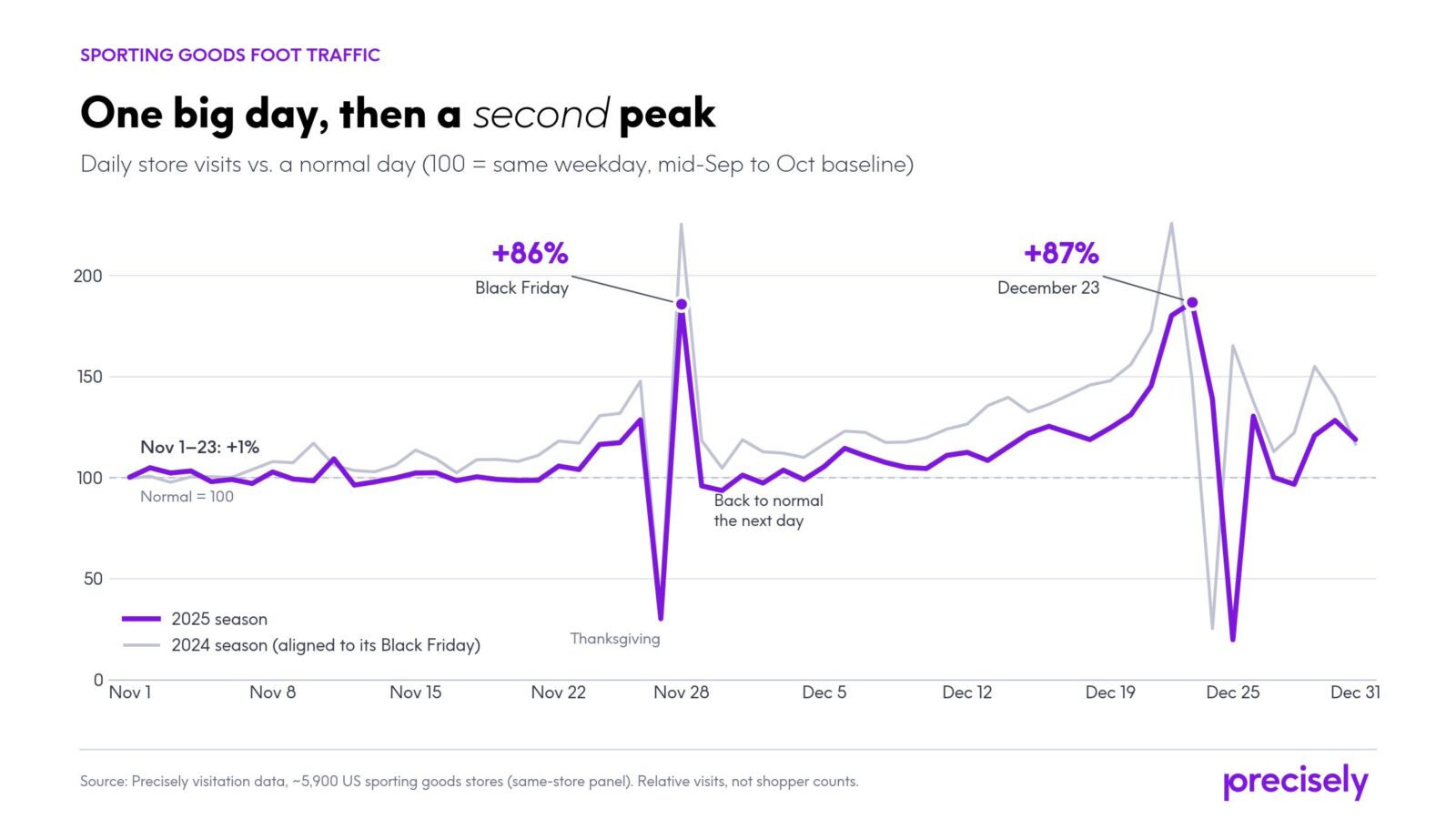
Chart 1. Visits stayed near normal through most of November, then peaked on Black Friday and December 23.
The gains weren’t shared evenly. Compared with their own normal Friday traffic:
- Outdoor and hunting superstores drew nearly four times their usual Black Friday visits
- Big-box sporting goods chains roughly tripled theirs
- Independent shops saw a 59% lift
Method note: Precisely visitation data for about 5,900 US sporting goods stores (same-store panel). Each day is compared with the same weekday in a mid-September to October baseline. Figures show relative visits, not shopper counts. 86% is the all-store average.
A two-peak season puts every data decision to the test
A spike like this leaves one shot at having the right products, people, and offers in place. A customer who appears in three systems, a product listing that’s wrong in one place, or a store plan built on stale information all surface at the worst possible moment.
Location context helps. Knowing which store types draw crowds, when they peak, and where shoppers go next lets retailers plan staffing, inventory, and promotions with evidence instead of instinct. That’s the idea behind location intelligence, and what retailers see on Black Friday can shape how they prepare for the second peak.
Building the data foundation before the next peak
The new Precisely Platform, currently in preview, can help retailers build the data foundation they need to stay prepared.
It’s a unified data management platform that brings together data integration, data quality, data governance, location intelligence, master data management, and customer communications on a shared metadata and semantic foundation. Built-in data enrichment adds business and location context, and the Platform manages data where it lives, so you don’t have to migrate everything into one ecosystem first.
Precisely AI Studio offers ready-made apps, agents, and skills, and retailers can explore and trial them for free, including data enrichment and location intelligence solutions.
If last year’s pattern holds for retailers, Black Friday is only the first peak, and another is on the way. The best-prepared won’t necessarily have the most AI tools. They’ll have data that’s ready for the tools they already have.
Foot traffic tells you when shoppers show up. AI-ready data helps you be ready when they do. Learn more about our data-driven retail solutions.