


Key Takeaways
- Automation is now standard in SAP® environments, with 61% of organizations using it and best-of-breed strategies up 14 percentage points in a single year.
- AI is already present in most SAP environments, led by Microsoft Copilot at 60%, but only 3% report fully automated, AI-driven processes.
- SAP S/4HANA migrations are getting harder as more teams go live, with handling ECC customizations now the top barrier at 53%.
In 2023, 13% of the SAP stakeholders surveyed by Precisely and ASUG reported no automation maturity. In 2026, that number is 3%. Automation has become part of how SAP-run organizations operate, which sounds like a finish line until you look at what comes next.
The newest data on SAP automation trends for 2027 shows a market moving from adoption to execution. AI is entering SAP workflows, S/4HANA® migrations are surfacing harder problems, and the questions facing IT leaders and business process owners now center on scale, skills, and trust in the data.
All of this is covered in our new Advancing Automation, AI, and Process Transformation in SAP: 2027 Trends and Challenges report, our fourth consecutive year of research with the Americas SAP Users Group (ASUG), based on responses from 169 SAP stakeholders. Here’s a preview of what’s inside, and why it matters.
What the SAP automation trends for 2027 say about maturity and strategy
Automation usage for SAP migrations and digital transformation reached 61%, up from 57% last year, and the share of organizations still searching for the right approach has fallen to just 5%. The more telling shift is in strategy. Best-of-breed adoption jumped from 19% to 33% in one year, a sign that teams with more mature programs are settling on a core set of tools they can apply across many SAP use cases instead of choosing solutions one at a time.
Business-user enablement is rising alongside it.
- 71% of respondents rate citizen development as “important” or “very important.”
- 84% say no-code/low-code capabilities matter when choosing an SAP automation platform.
And yet, the largest share of organizations still relies on SAP IT developers to build automation, so the aspiration is running ahead of the reality. The full report shows who is building automation today, which tools respondents prefer, and how many teams now need to connect SAP data with systems like ServiceNow and Salesforce.
ANALYST REPORT
Advancing Automation, AI, and Process Transformation in SAP®: 2027 Trends and Challenges
See the trends shaping automation and process transformation for 2027, and use the findings as a benchmark to compare your organization’s priorities with other SAP teams. Read the latest research from Precisely and the Americas SAP Users Group (ASUG).
How are SAP teams using AI and AI agents?
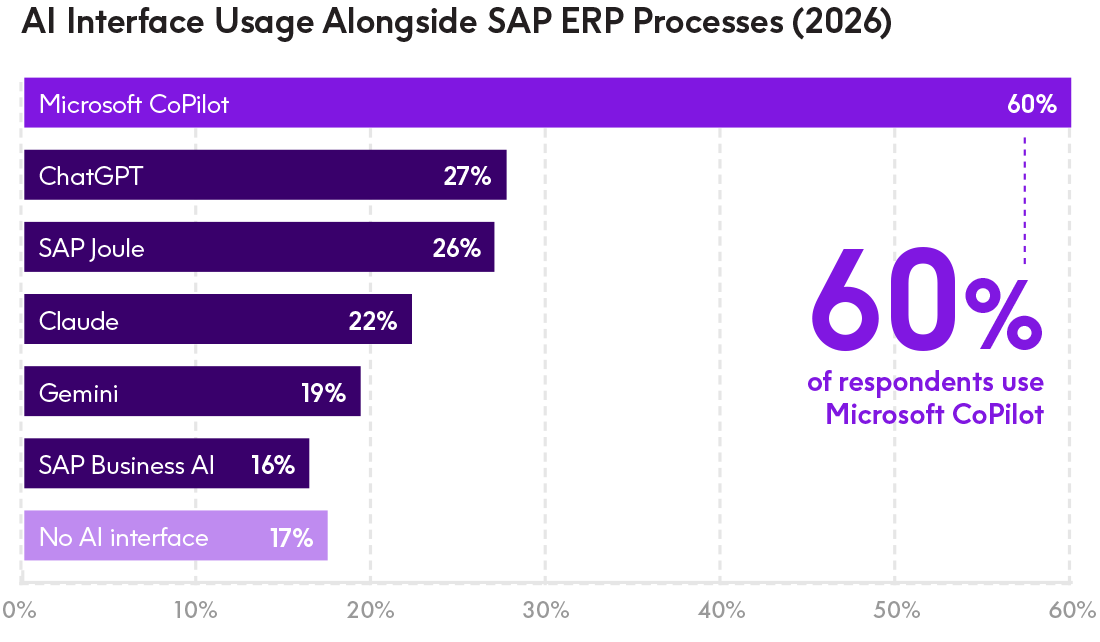
This is the first year our research with ASUG has examined AI and AI agents in SAP automation, and the headline is that AI is already here.
- Only 17% of respondents report using no AI interface alongside their SAP ERP processes.
- Microsoft Copilot usage leads at 60%.
- Adoption of fully automated AI-driven processes is cautious overall, at just 3%.
- 46% use AI for a mix of automated and human-assisted tasks.
- 51% describe themselves as early explorers when it comes to AI-assisted development.
Maturity makes a visible difference. The most advanced automation programs are further along with AI, and the report shows how their experience compares with everyone else’s.
In our experience, AI works best when it sits on top of mature automation foundations and trusted data. AI doesn’t stop to question. When the data is wrong, it acts anyway. That’s why AI-ready data, which is visible, reliable, accountable, and complete, matters so much in SAP environments where master data and process governance carry high stakes.
Why are SAP S/4HANA migrations getting harder as more teams go live?
Momentum is strong. 67% of organizations are now fully or partially live on SAP® S/4HANA, up from 59% in 2025, and only 1% report no plans to migrate.
The harder part is what remains. Handling ECC customizations is now the top migration challenge at 53%, and transferring process complexity and complex data transformation are among the fastest-rising barriers.
Data cleansing tells a similar story. 83% of respondents still consider SAP master data cleansing important to migration, yet fewer organizations are fully cleansing before they move, and more are pushing the work to during or after migration.
We see many companies get close to go-live only to be stopped by data and process surprises that no one planned for. The report explains how organizations using automation platforms to move complex data and processes report lower rates of these challenges.
What is changing with SAP Fiori and SAP BTP?
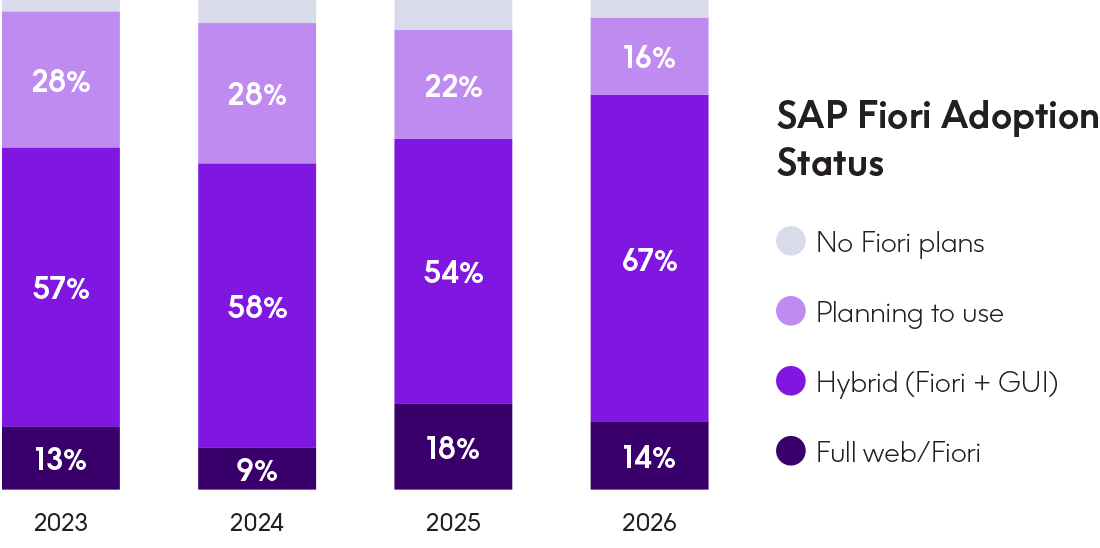
SAP® Fiori has reached a tipping point. 81% of organizations now use it in some form, and GUI-only holdouts are down to 2%. Most are living in both worlds: 67% run Fiori alongside SAP GUI, which means automation has to work consistently across both interfaces.
SAP® Business Technology Platform (BTP) adoption keeps climbing, with more than half of respondents now using BTP services. The more interesting story is what they use it for and what holds them back.
Among established users, automation and AI show the biggest gains, and the main barrier has moved from understanding what BTP offers to having the skills and resources to execute. The report breaks down which capabilities are growing fastest and how organizations decide between BTP and third-party tools.
Who will get the most from this SAP research report?
If you lead SAP IT, enterprise architecture, or a migration program, the report gives you benchmarks for planning timelines, staffing, and BTP strategy. If you own business processes in finance, master data, or supply chain, it shows how peers are approaching automation and AI agents in the same areas. If you run an automation or citizen development program, it shows where your maturity and tool strategy stand against others.
Respondents span industries from consumer products and manufacturing to healthcare and utilities, so these SAP automation trends for 2027 reflect a broad cross-section of SAP-run organizations.
The through line across four years of this research is complexity: legacy processes, fragmented data, and constrained internal capacity. Organizations that address it with strong automation foundations, data quality management, citizen development, and unified data management are better positioned to get the most from their SAP investments as they modernize.
The trends highlighted here are a starting point. The full report shows how the picture changes by maturity level, where peers are investing, and what separates the organizations making the most progress. Get your copy of Advancing Automation, AI, and Process Transformation in SAP: 2027 Trends and Challenges to see the full findings and benchmark your SAP journey against your peers.
Frequently asked questions
What is the Precisely and ASUG SAP automation report?
It is an annual research report from Precisely and the Americas SAP Users Group (ASUG), now in its fourth consecutive year. The 2027 edition is based on a survey of 169 SAP stakeholders and covers automation adoption and maturity, AI and AI agents, SAP S/4HANA migration, SAP Fiori, and SAP BTP.
How many SAP organizations are using AI alongside SAP ERP?
According to the research, only 17% of respondents report using no AI interface with their SAP ERP processes. Microsoft Copilot leads at 60%, and only 3% report fully automated, AI-driven processes, which shows most organizations are using AI to support human judgment.
What is the biggest challenge in migrating from SAP ECC to SAP S/4HANA?
Handling customizations built in SAP ECC is the top reported migration challenge, cited by 53% of respondents. Transferring process complexity and complex data transformation are also among the fastest-rising barriers.
What is the difference between best-of-breed and case-by-case SAP automation?
A case-by-case approach selects automation tools one use case at a time. A best-of-breed approach standardizes on a core set of specialized tools that can be applied across multiple SAP use cases and business functions. Best-of-breed adoption rose from 19% to 33% in the latest survey.