
eBook
Multi-Domain MDM: Mastering Modern Data Management Challenges
The time has come to liberate your data from single-domain silos.
Organizations today are critically reliant on data. When harnessed, high-quality data can be the lifeblood of an organization, flowing through an enterprise to drive intelligence, innovation, and growth.
Yet all too often, companies can be overwhelmed by their data. Enterprise companies have grown to depend on multiple systems: ERP, warehouse, e-commerce, call center, CRM, accounting—the list goes on. Each system receives pieces of information by the system owner, and that data is managed, updated, and retired by the administrator of each system independently.
With the importance of trustworthy and timely data on the rise, Master Data Management (MDM) and data governance are ranking high on the radar of organizations, from the CEO and CMO to users along the lines of business.
This eBook introduces the attributes and impact of Multi-Domain Master Data Management, with guidance on how to get the most from your MDM journey. Learn more.

Get your eBook copy now
* indicates required fields

Multi-Domain MDM: Mastering Modern Data Management Challenges
The time has come to liberate your data from single-domain silos. This eBook introduces the attributes and advantages of Multi-Domain Master Data Management (MDM), with guidance on how to get the most from your MDM journey.
Introduction
AI has raised the stakes for master data. Enterprises are moving beyond AI that produces insights and toward agentic AI that updates records, triggers workflows, and acts on its own. These systems are only as reliable as the data underneath them, so accurate, complete, and connected master data now decides whether they help the business or harm it.
As a result, Master Data Management (MDM) has returned to the center of the enterprise agenda, commanding attention from the CEO and CMO down to the data teams across the lines of business.
Most enterprises do not yet have a single, trusted view of their data to build on. They depend on many systems of record: ERP, warehouse, e-commerce, call center, CRM, and accounting, with more added every year. Each administrator manages, updates, and retires that data independently, leaving the organization without one version of the truth for the products, customers, suppliers, and locations that run the business.
This eBook introduces the attributes and advantages of Multi-Domain MDM. It explains how unifying these domains creates a trusted foundation and prepares your data for what AI demands next.
“[MDM is] evolving from a static, back-office systems of record into dynamic, real-time systems of intelligence essential for the AI era.”
Gartner
Why Siloed Domains Don’t Stack Up
Early MDM solutions focused on a single domain, usually the customer or the product. That narrow approach ignores the basic fact that data flows in from many sources that are critically related.
Without connecting and relating those domains, organizations only build deeper silos of fragmented data, and AI trained or acting on that fragmented data inherits every gap and inconsistency in it.
Enter Multi-Domain MDM
AI is what makes this urgent. An agent answering a customer question or acting on an order does not pull from one domain. It needs the customer, product, location, and supplier records to line up, and siloed domains cannot give it that.
Multi-Domain MDM brings those sources together on a single platform, with unified governance, modeling, mapping, and management across every domain. The result is one trusted foundation the business can run on and build AI on.
By creating a clear and holistic view of enterprise-wide information, Multi-Domain MDM helps eliminate the guesswork and uncertainty that results from data gaps and inconsistencies.
With Multi-Domain MDM, businesses can:
- Create a “golden record” for data entities by integrating databases and systems such as ERP, CRM, WMS, and OMS, and even hard-to-integrate legacy systems that are difficult to access and even more difficult to decommission.
- Enhance data quality with the ability to extract, load, publish, and syndicate accurate and consistent content to internal and external recipients.
- Improve the efficiencies and quality of decisions for enterprise processes that rely on trusted and accurate information.
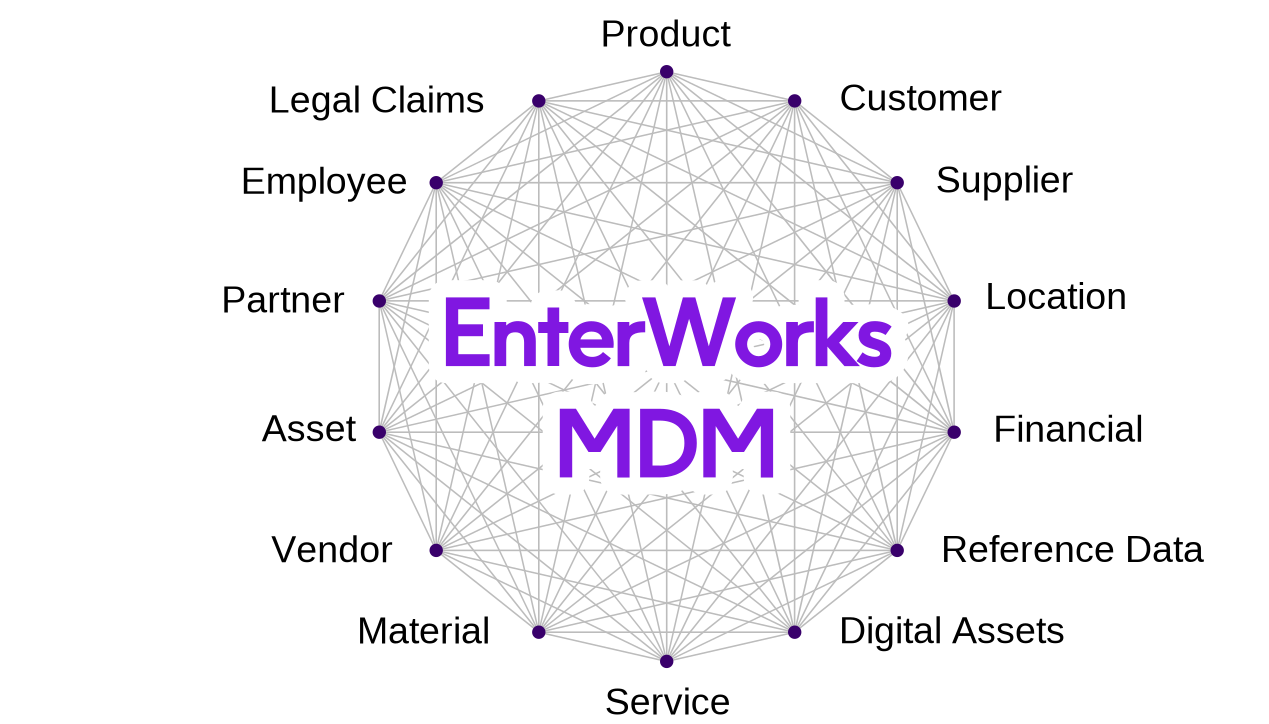
- Integrate views of a variety of domains including customers, products, suppliers, employees, assets, references, locations, and other core components of the enterprise.
- Reduce costs, streamline information management, and deliver accurate, complete, timely, and consistent views of information that are critical to achieving business objectives and strategies.
Single Domain vs. Multi-Domain MDM
- Cost: Operating multiple siloed domains is costlier than one centralized multi-domain hub that meets all requirements.
- Resources: Single-domain solutions result in wasted implementation resources, as well as redundant training and maintenance.
- Governance: Retaining single-domain silos causes organizations to face constant barriers in data governance practices.
- Agility: Single-domain solutions lead to slower responses and time-to-market because the business lacks common references and business rules across domains.
The Intersection of AI and MDM
AI is the reason master data management is back at the top of the agenda. After years of MDM being treated as back-office plumbing, analysts and enterprises alike have returned to it, because AI exposed the uncomfortable truth that models and agents are only as good as the master data beneath them. However, the relationship runs both ways. AI is changing how master data is managed, and master data is what determines whether AI can be trusted.
AI for Enhancing MDM outcomes
AI is transforming how master data is managed, making MDM processes faster, smarter, and more scalable. Rather than relying solely on semi-automated data matching, validation, and enrichment, organizations are using AI to automate tasks that once required significant human effort. Modern MDM solutions can generate suggested product descriptions from structured data, translate content across languages for global markets, and extract metadata from images and documents to enrich records automatically.
AI is also changing how teams interact with master data. Through natural language, a user can ask which products are missing a description, where a SKU sits in the hierarchy, or which suppliers have incomplete data, and get answers instantly without manual exports or spreadsheets.
By embedding these capabilities within MDM, organizations reduce manual workloads, accelerate time to value, and improve the consistency and accuracy of mastered data across domains. The most effective teams start with targeted AI capabilities, measure results quickly, then expand across processes and domains.
MDM for Enhancing AI Initiatives
At the same time, MDM provides the foundation that lets enterprise AI initiatives succeed. Before an agent acts, MDM ensures the data underneath it is accurate, consistent, and connected.
Master data such as products, customers, suppliers, and locations is the factual core of an organization. When it is mastered, it gives agents the trustworthy inputs they need to operate seamlessly across systems and functions and speak the same language. This is what empowers agents to run safely in production environments.
And getting there does not require an organization to have perfect data across every domain. The organizations seeing real ROI with their agentic initiatives start with a specific use case, master and enrich the data it depends on, then expand from there.
AI and MDM are converging to create a more intelligent and trustworthy data ecosystem. AI enhances the speed and precision of master data management, while MDM ensures that broader AI initiatives, including agents that act autonomously, operate on the most accurate and contextual data possible. Organizations that embrace both together will move faster, act with greater confidence, and realize greater value from every data-driven initiative.
Enabling Cross-Domain Intelligence Through Multi-Domain MDM
Enterprise companies have grown to depend on multiple systems, each with their own internal and external sources of data. With Multi-Domain MDM, single data domains like the customer, the product, and the supplier are merged, cleansed, and enriched.
Multi-Domain MDM offers a 360-degree view of data across domains. Data comes in from a variety of sources, is filtered into the MDM system, and then linked to other data and domains. Linking the domains this way unlocks intelligence that no siloed system can deliver alone.
Consider what an organization can accomplish once it centralizes its customer master data and links it to sales and product data.
Finance can reconcile sales numbers across regions and business units because every system references the same customer and product records, instead of stitching conflicting versions together by hand. Reporting rolls up cleanly by vertical, since the underlying records share one definition and one hierarchy.
Sales teams gain from the same foundation. When customer records are unified and connected to opportunity data, a rep can see which existing customers map to open opportunities, where an account is already active elsewhere in the business, and where there is room to expand. None of that is reliable when the same customer exists under three different names across three systems.
When information is updated only in siloed systems, enterprises lose the intelligence that comes from touchpoints communicating with each other. When they centralize data through MDM, decisions and actions run on a single source of truth.
of leaders say their data is AI-ready, yet 43% cite data readiness as their biggest obstacle to AI - Lebow
0
%

Data Without Rules
Finally, it’s important to note that the benefits of MDM aren’t the results of simply managing data or information. MDM capabilities are inert unless integrated with business applications that leverage the data.
Multi-Domain MDM includes several features that bring the value of data to life, including:
Synchronization:
Synchronizing master data efficiently and effectively to multiple systems, channels, and touchpoints is one of the strengths of a Multi-Domain MDM platform. This encompasses collecting, ingesting, federating (synchronization with internal systems) and syndicating (synchronization outside the organization). The MDM system can manage bi-directional data synchronization and acts as a “command and control” center that can power and govern data across a variety of applications.
Workflow
Multi-Domain MDM is uniquely designed to integrate with automated workflow and business process rules that help provide the “kinetic energy” that underlies the applications leveraging master data and information. With the recording of workflow steps and reporting capabilities, companies can benchmark their performance over time on key business processes related to MDM, such as new product introductions, assortment planning, catalog layout, vendor data onboarding, data governance and data cleansing.
The Data Governance Difference:
Stronger governance is what turns mastered data into better decisions and, increasingly, into AI the business can trust. Better governance produces better data, better data produces better insights, and trustworthy data is what makes agentic AI safe to act on. That chain is one of the most significant reasons master data management matters now.
Most MDM solutions govern master data at the operational level, through stewardship, workflows, and record-level controls. What they lack are the capabilities of an enterprise-wide metadata governance program. Integrated with a more robust data governance solution, the value compounds. Governance teams can catalog key attributes, apply consistent definitions in a shared glossary, and trace how those attributes change over time.
Connecting mastered data to governance frameworks also lets organizations tie data assets to business goals, metrics, and KPIs, which is where MDM finally becomes measurable. Instead of claiming value in the abstract, teams can point to faster product onboarding, fewer returns from bad data, less manual reconciliation, and quicker audits. Linking those outcomes to named metrics is how leaders demonstrate ROI and keep enterprise confidence in their most critical data.

Connecting the Domain Dots
Multi-Domain MDM enables organizations to manage multiple domains of data and easily link objects from those domains to create dynamic virtual relationships. All administrative, stewardship, and governance functions across the multiple domains (and implementation styles) can be achieved from a single user interface.
Product Master
Managing product data across thousands or even millions of attributes is a daunting task. From retailers to distributors and manufacturers, all organizations are challenged to stay competitive and keep product information current, consistent, and compelling, especially when it is scattered across disparate spreadsheets and systems. Multi-Domain MDM with a Product Master Domain helps companies:
- Consolidate product information by ingesting every source system into one golden record, so teams stop reconciling conflicting entries by hand.
- Deliver a consistent omnichannel experience by syndicating that record to each channel in the format it requires, from website to catalog to point of sale to partner systems.
- Reduce time to market by running new products through workflows that validate required attributes and route approvals automatically.
- Meet evolving regulations and standards by tying compliance fields directly to the product record, so required data is captured at the source and inherited downstream.
68% of organizations named ‘the number of data silos’ as their top data management challenge
DATAVERSITY
Customer Master
Customer data is high volume and constantly changing, spread across CRM, support, billing, and marketing systems that each hold their own version of the same person or company. As a high-volume merge domain, the Customer Master resolves those records into one accurate, governed profile. Multi-Domain MDM with a Customer Master Domain helps companies:
- Create one trusted customer record by matching and merging duplicates across systems, so sales, service, and finance all work from the same view instead of conflicting ones.
- Keep records current by updating the master when a verified change comes in, such as a rep learning on a call that a contact has moved into a new role.
- Enrich records by adding verified attributes from trusted sources, so the profile is optimized for accuracy and completeness.
- Connect customers to the other domains they touch, linking each account to its orders, locations, and the products it owns for a complete relationship view.

Vendor Master
An MDM platform manages vendor data alongside customer and product data, standardizing supplier records across brands and geographies. But the real value comes from connecting the Vendor Master to the domains it touches:
- Control purchasing costs by linking vendors to the products they supply, so teams can consolidate spend and negotiate from a complete view.
- Source and distribute more effectively by connecting vendors to location data, so teams know which suppliers serve which regions and sites.
- Act on brand preference by linking vendor and customer data, so teams can spot where customers favor a particular brand, including private and black label lines, and promote accordingly.
Location Master
Adding a Location Master enables business units across distribution, manufacturing, and retail to manage information related to store locations, manufacturing plants, warehouses, regions, and more. For example, if a manufacturer sells to a large retail chain, but certain products are not sold in certain regions, teams can track and link this product and location information to ensure the right inventory is sent to the correct stores.

Asset Master
An Asset Master, including Digital Asset Management (DAM), centrally stores and manages images, documents, templates, audio, video, and related metadata. Linking each asset to the records it belongs to keeps content consistent and easy to find, track, and report on, so the right image or document travels with the right product across every channel.
An Asset Master also manages physical assets, such as construction equipment or spare parts. Tracking what equipment is available at each location helps ensure only compatible products are sent there.
Reference Master
A Reference Master brings reference data from internal and third-party sources into the MDM system, where it can be standardized once and reused across every domain and use case. Examples include color standards, units of measure, and currency exchange rates for pricing across different countries.
Other Domains Include:
-
Partner
-
Employee
-
Supplier or Contract
-
Service
-
Material
-
Schedule Data
Precisely EnterWorksTM software
EnterWorks has deep domain experience across manufacturing, retail, CPG, healthcare, insurance, and financial services. Rather than forcing your data into a fixed structure, EnterWorks models to the way your data already works, so you can start where you are today and master a single domain or all of them. Your entry point can be as simple or as complex as your business calls for.
Customers rely on EnterWorks Multi-Domain MDM to drive best-in-class customer experiences, streamline internal processes, keep data consistent across the value chain, and integrate trading partners to extend their brand.
Configure, not code

AI-ready data

Deep product expertise
Modeling Data
-
Heritage in complex data environments
-
Handle both structured and non-structured data
-
Flexibility; no coding to change
-
Solution adapts to business, not vice versa
Enriching Data
- Role based UI: flexible and easy to customize without coding
- Data governance: attribute-level security, flexible promotion/validation rules, flexible workflow, dashboard views
- All data treated as objects
Acquiring Data
- Strong data Integration technology and experience
- Collaborative supplier portals
- Workflow driven data input processes; internal and external people and systems
Sharing Data
- Multiple methods for exporting data – Push and/or Pull
- Automated syndication in target format
- 2-way dealer portals
- Multi-Channel publishing for print/online
Precisely MDM solution
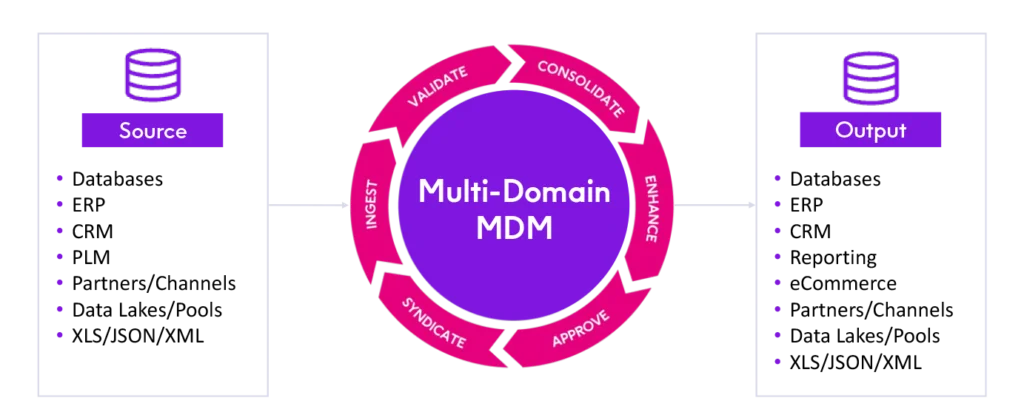
Precisely’s MDM solution provides a central, trusted repository of accurate, up-to-date master data consolidated from across enterprise applications. It ingests data from virtually any source, then normalizes, merges, and validates it to create a golden record: a single, authoritative source of truth. Data quality and governance controls keep that record consistent everywhere it is used, and syndication keeps it synchronized across the systems, channels, and partners that depend on it.
The solution masters multiple domains, including product, customer, vendor, location, financial, and reference data, along with the relationships between them. Its open, flexible data model adapts to your business rather than forcing your data into a predefined structure, so you can tailor domains, attributes, and hierarchies to your operating model and link them for cross-domain intelligence.
With EnterWorks, companies easily:
-
Ingest: Access data from all enterprise systems, applications, and files for mastering with our “configure, not code approach”
-
Validate: Apply business rules, quality checks, and address verification to ensure data is accurate and consistent.
-
Consolidate: Create a golden record and eliminate duplicates with match & merge and survivorship rules
-
Enhance: Create cross-domain relationships, connect digital assets, and enrich records with Precisely dataset
-
Approve: Execute workflows with role-based stewardship to enforce accountability and compliance
-
Synchronize & Syndicate: Share and publish trusted mastered data across systems, partners, and channels
Key Benefits
-
Establish one trusted view of data to improve operational effeciency
-
Synchronize partners & channels and accelerae time-to-value of products and services
-
Enhance customer & product experiences to drive revenue growth & brand loyalty
-
Ensure master data compliance and strengthen compliance & risk control
What sets Precisely MDM apart
Unlock AI-Ready Data
Leverage Precisely’s enhanced data enrichment capabilities with AI-powered partner solutions to unlock AI-ready master data
“Configure, not code” Approach
Support any data structure with an open & flexible data model that fits seamlessly into your tech stack, without requiring heavy IT investment
Expand Master Data Impact
Connect Precisely’s other data integrity solutions to verify and enrich location master data, create shared business definitions, and catalog and tie key MDM attributes to policies and KPIs to further prove ROI of your MDM initiative.
Deep Product Data Expertise
Accelerate product (PIM) initiatives with three decades of innovation and expertise, featuring advanced taxonomies and a built-in digital asset manager (DAM)
Support for MDM Success
Active community & customer events, ideas portal to shape future roadmaps, and optional 24/7 mission-critical support
Deployment Options
The product fully supports cloud, hybrid, and on-premises deployments.
Synchronization
-
Synchronization can be initiated manually, scheduled, and/or triggered by an event such as a change to the product record.
-
Out-of-the-box integration methods are supported, such as GDSN.
Data Security
Data security can be implemented at multiple levels. Access can be configured as read-only, read/write, or the object or attribute can be hidden from the user view altogether as well. Security can be set on the user role, user, object or entity, and even down to the attribute level.
Content in Context
Precisely’s Multi-Domain MDM supports the requirements for both online and offline products, serving up information to a variety of touchpoints from marketplaces to mobile, POS to Print, with workflow-driven and automated processes. This approach enables organizations that require combinatorial outputs to deliver personalized and targeted offers across various touchpoints with consistency. The strategy encompasses business-to-business (B2B), business-to-consumer (B2C), and business-to-business-to-consumer (B2B2C) use cases.

MDM Key Features:
-
Create your own master data domain
-
Open & flexible data modeling
-
Data quality: profiling, standardization, match, merge, and de-duplication
-
Address verification
-
AI-assisted auto classification
-
AI-assisted data image extraction
-
AI-assisted description writing
-
MCP Server
-
Built-in workflow engine & process automations
-
Rich hierachy & taxonomy management
-
Business-friendly UI
-
Data governance & stewardship
-
Versioning, audit, & lineage
-
Cross-domain intelligence
-
Advanced reporting
-
Digital Asset Manager (DAM)
-
Integration with broader Precisely Data Integrity portfolio and partners to further extend the value of Precisely MDM

Conclusion
A Multi-Domain MDM implementation can drive consistency and accuracy in data across your domains; reduce costs in implementation and maintenance; add a new level of data quality, governance, and stewardship across your enterprise. Ultimately, the goal of Multi-Domain MDM is to connect the dots between domains to enable an unparalleled level of intelligence around the relationships between products, customers, suppliers, and more.
Therefore, as you embark on your MDM journey, carefully consider how you will implement the technology, the best processes, and the practices that will best maintain, grow, and transform your business.
The right MDM partner empowers an organization to break down silos and establish a single trusted view of critical data, improve its quality, and synchronize it across internal and external channels to enhance internal, partner, and customer experiences.
Ready to master your data? If you’re considering implementing or switching MDM solutions, reach out to Precisely to learn more and see a custom demo. Tell us about your data challenges, and we’ll show you how a trusted master data foundation moves your business forward.
1. Gartner, Magic Quadrant for Master Data Management Solutions, April 2026.
2. 2026 State of Data Integrity and AI Readiness, Precisely and Drexel University’s LeBow College of Business, 2026.
3. DATAVERSITY, Trends in Data Management, 2024.. Gartner Research, October 11, 2007