
EBOOK
The Real-World Signal Advantage
How Modern Marketers Win with Location Intelligence
The Gap Between the Physical and Digital World
For years, marketers have built their targeting strategies on third-party cookies and online behavioral data. It’s worked well enough, but as cookies disappear, privacy regulations tighten, and consumers move fluidly between digital and physical spaces, that foundation is cracking.
Here’s the truth: most of what your customers do happens offline. They walk into stores. They visit competitors. They commute past your billboards and drive through your rivals’ parking lots. If your targeting strategy can’t see any of that, you’re making campaign decisions with a fundamentally incomplete picture.
The good news? The data that fills that gap already exists, in the form of real-world location signals. The brands learning to activate those signals intelligently are building a durable competitive advantage. The ones that aren’t are doubling down on a model that’s already showing its limits.
Read on to discover how to close that gap.

The shift happening right now
Third-party cookies are fading, and signal loss is real. But real-world visitation data — grounded in actual physical behavior — doesn’t depend on cookies, device IDs, or browser permissions. It’s one of the most durable targeting inputs available to modern marketers, and it only becomes more valuable as identity fragmentation accelerates.
Why Visitation Is a Different Kind of Signal
Digital intent is useful. If someone searches for “best running shoes” or spends time on a competitor’s product page, that’s worth knowing.
But intent doesn’t equal action. And online behavior has never been a clean proxy for what people actually do in the physical world.
Visitation data is different because it reflects revealed preference – not inferred interest, not modeled likelihood, but observable behavior.
- Someone who visits a home improvement store three times in a month tells you something real about where they are in a purchase journey.
- Someone who cross-shops two competing QSR chains on weekday lunches expresses a pattern you can act on.
That distinction matters enormously for targeting quality. When you build audiences from visitation signals, you’re working with people who have actually demonstrated interest, rather than people who are assumed to be interested.
These are durable, high-intent signals that work across every channel where cookies never mattered – including connected TV (CTV), digital-out-of-home (DOOH), and authenticated programmatic inventory.
What visitation signals can tell you:
- Who your best customers are – by real behaviors, not just demographics
- Who your competitors’ customers are, and how to reach them
- When and where your audiences are most likely to engage
- Which campaigns drove real-world outcomes, not just online clicks
Digital Intent Signals vs. Visitation Signals
|
Digital Intent Signals |
Visitation Signals |
|
Search history |
Store visits |
|
Page views |
Repeat visit frequency |
|
Click behavior |
Competitor cross-shopping |
|
Modeled interest |
Daypart patterns |
Precisely helps you reach the right audience
Precisely Audiences powered by PlaceIQ™ location data, delivers 1,500+ pre-built, privacy-compliant audience segments built from actual visitation patterns, rather than modeled intent or outdated lists. Every segment reflects what consumers actually do in the physical world, updated with daily visit intelligence.
Segments span retail, QSR, fitness, financial services, auto, and dozens of other verticals — ready to activate across major DSPs without manual onboarding or added contracts.
Activation Across Channels: What This Looks Like in Practice
High-quality audiences only create value when they’re easy to put to work. Here’s how real-world signals translate into action across the channels that matter most.
Identity & Interoperability
As signal loss accelerates, interoperability is everything. Integrations with identity platforms allow you to bring real-world visitation audiences into cookieless environments, reaching authenticated audiences using pseudonymous identifiers that travel with the user across devices and platforms, while staying aligned with evolving privacy standards.
Omnichannel Activation
Programmatic DSPs make it possible to activate visitation-based audience segments at scale — across CTV, open web, and mobile — without rebuilding your workflow every time you add a new signal type. The goal is consistency: the same audience intelligence powering every channel you buy.
DOOH: The Channel That Was Always Cookie-Free
Digital out-of-home has always operated outside the cookie ecosystem — and that’s exactly why location signals are so powerful here. By connecting visitation data to programmatic DOOH buying, you can extend your audience strategy into real-world media environments with the same targeting precision and measurability you expect from digital.
Retail Media Networks
Retail media is one of the most important advertising environments right now — combining first-party retailer data with media delivery across on-site, off-site, and in-store placements. Visitation-based audience signals complement this by providing consistent cross-platform context and enabling measurement that connects media exposure to real-world outcomes beyond the retailer’s own walls.
Beyond syndicated audiences, many advertisers need segments that reflect their specific business rules, geographic footprint, and category dynamics. Custom audience builds — combining visitation with demographic context, cross-shopping behavior, purchase-driven signals, and property or household attributes — let you move from off-the-shelf to purpose-built without the operational friction.
Precisely results: Win-backs for a quick service restaurant
A national QSR chain wanted to re-engage lapsed customers and pull share from competitors. Using visitation-based segmentation, they identified people who had historically visited their locations but recently shifted. They activated a targeted campaign and measured the real-world result:
83% more store visits. No cookies required, and no guesswork about intent.

Meet signal engine
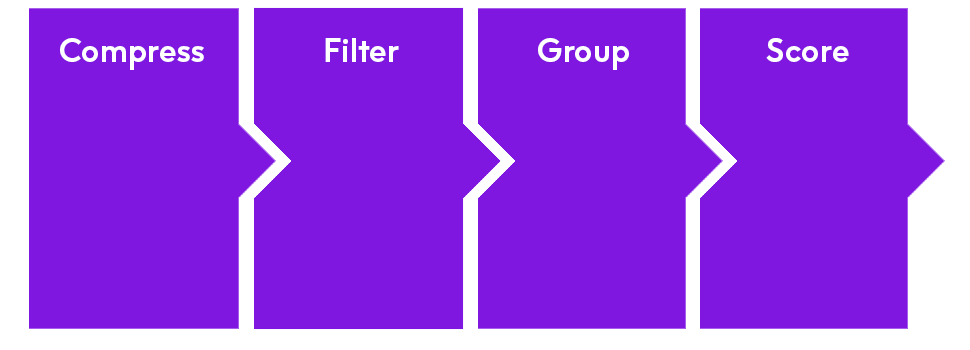
Signal Engine is the privacy-first visit intelligence engine from Precisely — built to run entirely inside your cloud infrastructure. It processes your raw, timestamped mobility signals through a four-stage pipeline:
- Compress — removes redundant signals while preserving accuracy.
- Filter — eliminates GPS drift, anomalies, and unrealistic movement.
- Group — clusters events into visits using spatiotemporal logic.
- Score — assigns a confidence level using POI proximity, parcel data, and movement patterns.
- The result: clean, confidence-scored visitation data you can activate instantly — without sharing it with anyone.
Your First-Party Location Data Is Probably Underworked
Here’s something that might surprise you: many of the organizations sitting on the most valuable location data in their category aren’t doing much with it.
If your platform, app, or service generates timestamped mobility signals — GPS pings, visit logs, device movement data — you already have the raw material for powerful audience intelligence, attribution models, and behavioral analytics. The challenge is that raw location data is noisy. GPS drift, anomalous movement, and signal redundancy mean that turning raw pings into clean, actionable visit records is genuinely hard to do at scale.
Most organizations address this by sharing their data with a third-party processor. And that’s where privacy risk enters the picture.
There’s a better model: processing your location data entirely within your own cloud environment, without ever moving it outside your firewall.
This approach matters for every organization serious about data sovereignty:
- Retail media networks that want to build high-confidence audiences without shared IDs.
- Media and AdTech platforms that need to feed DSPs with real-world signals without cookie requirements.
- Telecom and logistics companies analyzing movement patterns for network planning.
- Financial services firms attributing visits and enriching analytics, privately.
The principle is the same across all of them: your location data is a competitive asset. Treating it like one means processing it on your terms.
On data sovereignty
The strongest competitive moats in data are built on signals your competitors can’t replicate. If you’re processing your first-party location data through a shared third-party environment, you’re accepting privacy risk and diluting what makes your data uniquely yours.
Closing the Loop: From Exposure to Outcome
Activation is only half the equation. The other half is proving that your campaigns actually moved the needle in the real world.
This is where traditional digital measurement falls short. If a consumer sees your CTV ad on Tuesday and walks into your store on Friday, a last-click attribution model will never connect those two events. You’ll undervalue your upper-funnel spend, misattribute the conversion, and make the wrong investment decisions next quarter.
Visitation-based measurement closes that loop. By analyzing aggregated foot traffic patterns before and after campaign exposure — across locations, dayparts, and channels — you get a clear view of what’s actually driving real-world behavior.
This matters especially for omnichannel campaigns, where performance can’t be captured by clicks alone. A DOOH placement that lifts store visits by 12% is doing its job, but you’ll never know that without measurement built on real-world signals.
Measurement at scale
Place Visit Stream delivers aggregated visitation measurement at scale, giving marketers and measurement partners a way to evaluate outcomes like store visits by location, daypart, or channel — without exposing individual-level data.
Combined with identity and interoperability partners, this enables closed-loop attribution across even walled garden platforms — connecting ad exposure on social or streaming to verified in-store visits.
A growing focus across the industry is connecting ad exposure to real outcomes on walled garden platforms. By pairing real-world audience segmentation with privacy-forward identity solutions and server-side conversion APIs, advertisers can optimize and measure using real-world outcomes — not just online events — while keeping data handling aligned with platform policies and privacy requirements.
The result is a measurement framework that finally matches the complexity of how modern consumers actually behave: across devices, channels, and the physical world.
The Signal That Doesn’t Fade
As identity continues to shift and channels continue to fragment, real-world signals remain one of the most durable inputs for modern marketing.
They don’t depend on cookies. They’re not modeled from proxies. They reflect what your customers actually do, and they’re available today, at scale, in the channels where you already buy media.
The marketers who will win the next chapter of advertising are building strategies now on the signals that already exist in the physical world.
Your customers are out there. They’re visiting stores, exploring competitors, making decisions. The question is whether your campaigns can see them — and reach them — where it counts.
Ready to activate your location signals?
Precisely Audiences gives you 1,500+ pre-built, privacy-safe segments built from real visitation data — ready to activate across your existing DSP relationships.
Signal Engine brings that same intelligence in-house, processing your first-party location data into confidence-scored visit records inside your own cloud environment.